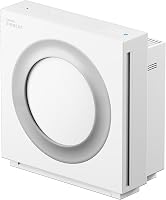
How to Choose an Air Purifier: Size, CADR, Filters
Choose an air purifier by matching its CADR to your room volume and target air-change rate. Then check that its filters, everyday fan noise and replacement needs fit the way you'll use it.
On this page (10 sections)
- What does air purifier CADR tell you?
- How do you match CADR to room size?
- Why do room-coverage claims look so different?
- Should you compare smoke, dust or pollen CADR?
- What filter types should you look for?
- Which of these air purifiers fits your room?
- How should you set up and run an air purifier?
- How should filter replacement affect your choice?
- Which air purifier buying mistakes should you avoid?
- How do you make the final air purifier CADR decision?
Choose an air purifier by matching its CADR to your room volume and target air-change rate, then check its filters and care needs. Air purifier CADR tells you how much clean air a unit supplies for particles such as smoke, dust and pollen.
Start with the room where you'll use it most. A purifier sized for a bedroom won't provide the same cleaning rate across an open living area.
For a broader starting point, see our air purifier guide for different homes and needs.
What does air purifier CADR tell you?
Air purifier CADR measures particle-cleaning capacity, expressed in cubic feet per minute, or CFM. Higher figures mean more clean air delivered each minute under the measurement conditions.
Think of CADR as the combined result of airflow and particle removal. A filter's capture percentage describes only part of that picture, because room cleaning also depends on how much air passes through it.
Smoke, dust and pollen have separate CADR figures because a purifier can perform differently across particle types. Compare smoke with smoke or pollen with pollen when choosing between models.
CADR does not measure odor or gas removal. It also doesn't show whether a purifier will distribute clean air evenly through several rooms.
Look for an AHAM VERIFIDE mark when you want independently checked performance. AHAM's air cleaner guidance explains the program and its room-size information.
Which fan speed does air purifier CADR describe?
Treat the maximum CADR as the purifier's top-speed capacity unless the brand specifies another setting. Turning the fan down usually reduces clean-air delivery.
This matters when you plan to use Sleep Mode every night. A model that only meets your room's needs at its highest speed may offer less capacity than you want at bedtime.
Some extra capacity gives you more flexibility to reduce fan speed, but don't assume a larger unit meets a specific CADR on low. Use speed-specific figures when available.
How do you match CADR to room size?
Calculate the room's air volume, then choose the cleaning rate you want. Floor area alone leaves out ceiling height, which changes how much air the purifier must handle.
Measure length and width in feet, then multiply them for square footage. Multiply that result by ceiling height to get cubic feet.
Use this formula when CADR is expressed in CFM:
Required CADR = room volume × target air changes per hour ÷ 60
For example, a room measuring 15 ft by 20 ft with an 8 ft ceiling contains 2,400 cubic feet of air. At 4.8 air changes per hour, it needs 192 CFM of clean-air delivery.
At 2 air changes per hour, that same room needs 80 CFM. Both calculations describe the same space, but the first provides more frequent particle cleaning.
An air change expresses clean-air delivery relative to room volume. It doesn't mean every particle disappears once that amount of air has passed through the purifier.
How should you choose an air-change target?
Use several air changes per hour as a practical comparison point for an occupied room where particle reduction matters. Around 4 to 5 provides a more useful frequent-cleaning benchmark than a once-per-hour coverage claim.
This is a sizing benchmark, not a promise of a particular health result. The amount of pollution entering the room and the way air moves through it still matter.
A high ceiling raises the capacity requirement even when floor area stays the same. A 10 ft ceiling contains 25% more air than an 8 ft ceiling over the same footprint.
For help measuring unusual layouts, use our air purifier square footage calculator guide. Include connected areas that stay open, rather than measuring only the seating area around the purifier.
Why do room-coverage claims look so different?
Coverage claims differ because brands can use different cleaning intervals. Compare square footage and time together.
The Levoit Core 300-P illustrates this clearly: Levoit gives 222 sq ft at 4.8 air changes per hour and 1,073 sq ft at one air change per hour. The larger figure represents slower cleaning across more space.
Blueair gives the Blue 211i Max coverage of 674 sq ft in 12.5 minutes and 3,235 sq ft in one hour. Winix gives the 5520 an AHAM-verified room size of 392 sq ft and one-hour coverage of 1,882 sq ft.
For frequent room cleaning, focus on the smaller-area figures tied to shorter intervals. Don't compare one brand's one-hour coverage with another brand's coverage at several air changes per hour.
A doorway also isn't a promise of useful airflow into the next room. Separate bedrooms with closed doors usually need their own plan, even if their combined floor area falls below a large coverage claim.
Should you compare smoke, dust or pollen CADR?
Compare the CADR for the particle you care about most. If you want one consistent starting point for mixed particle concerns, use smoke CADR across all models that provide it.
Here is a like-for-like comparison of the 2 Levoit models:
| Model | Smoke CADR | Dust CADR | Pollen CADR |
|---|---|---|---|
| Levoit Core 300-P | 143 CFM | 153 CFM | 167 CFM |
| Levoit Vital 200S-P | 250 CFM | 254 CFM | 289 CFM |
For these models, smoke CADR is the lowest figure. Comparing the Core's smoke number with the Vital's pollen number would exaggerate their difference for smoke particles.
Pollen CADR is useful when seasonal pollen is your main concern. Keep room size in the decision too, because a relevant filter still needs enough airflow for the space.
Read our guide to air purifiers and allergy concerns for the role of filtration alongside cleaning and source control.
Smoke CADR covers smoke particles, not the full mixture of gases and odors in smoke. Removing a smell is also not proof that a room's air is safe.
What filter types should you look for?
Choose a particle filter for airborne dust, pollen, dander and smoke particles. Add carbon filtration to your checklist when odors or some gases are also a concern.
HEPA describes particle filtration, while CADR describes clean-air delivery. Use both to understand the purifier rather than choosing only by a capture percentage.
Levoit describes the Core 300-P's Original Filter as HEPA-grade while operating in Sleep Mode.
Our HEPA vs. True HEPA guide explains why filter terms and operating conditions deserve attention.
A pre-filter catches larger material before it reaches the finer filter. This can make routine hair and dust removal easier, especially in pet homes.
Carbon has a different job from a particle filter. Its usefulness for gases depends on the carbon amount, design and pollutant, so a carbon layer alone doesn't establish how much odor control you'll get.
Keep using an exhaust fan for cooking and address ongoing smoke sources. For that use case, read what an air purifier can and cannot do for smoke.
Which of these air purifiers fits your room?
Choose the Core 300-P for a smaller room, the Vital 200S-P for more particle-cleaning capacity, the Blueair for a larger shared space, or the Winix for its combination of filters and automatic controls. Size the room first, then use the differences below to narrow your choice.
Levoit Core 300-P: for smaller rooms and manual control
The Core 300-P suits a bedroom or office that fits its frequent-cleaning coverage. Choose it when you prefer setting the fan yourself and don't need app control or Auto Mode.
Its display lights can be turned off, and it has a timer and check-filter indicator. Levoit gives a 24 dB noise figure in Sleep Mode, which describes that quiet setting rather than maximum airflow.
Skip it for a large open living area if you want frequent air cleaning throughout the space. Also skip it if you expect the fan to respond automatically to changes in air quality.
Levoit recommends replacing its filter every 6 to 8 months and using official replacement filters. This model is for 120V use in the United States.
Levoit Vital 200S-P: for larger rooms with pets
The Vital 200S-P suits buyers who need more particle-cleaning capacity than the Core and want an intake designed with pet hair in mind. It combines a traditional inlet with an additional U-shaped inlet.
Use the CADR figures above to calculate its fit for your room and preferred cleaning rate. Its advertised coverage of up to 1,875 sq ft shouldn't replace that calculation.
It measures 14.96 by 8.66 by 19.69 inches, so measure the intended floor space before choosing it for a tight bedroom. Leave room for the airflow clearance and filter access required by its manual.
Skip it if you only need to serve a small enclosed room and prefer a smaller unit. It also won't collect all pet hair from floors and furniture, so keep vacuuming and grooming in your routine.
Blueair Blue 211i Max: for larger shared spaces
The Blueair suits a large living room or open shared area where you want automatic fan adjustment and remote control. Its air-quality sensors can adjust the fan, while the app supports monitoring, scheduling and filter-life tracking.
It uses Blueair's HEPASilent system, which combines mechanical and electrostatic filtration. The washable fabric pre-filter provides a separate care step for larger material.
Plan for its 14.4 by 14.4 inch footprint and 22.7 inch height. Its 360-degree intake needs an open position where furniture and curtains won't block incoming air.
Skip it if you can't provide suitable clearance or mainly need a small bedroom unit. Don't treat its large one-hour coverage figure as a reason to place one purifier in a hallway and expect equal cleaning behind closed doors.
Winix 5520: for rooms needing automatic controls and odor support
The Winix suits buyers who want a particle filter, carbon odor control and automatic fan adjustment in one unit. Its air-quality indicator provides a visible room reading, and the Winix Smart App allows remote control and monitoring.
Winix says its carbon filter reduces household odors and VOCs. A washable fine mesh pre-filter catches larger airborne material before it reaches the other filters.
Its light-sensitive Sleep Mode activates when the room darkens and returns to Auto Mode when light returns. Consider that behavior if you keep a home office or bedroom dark during the day.
Skip it if you expect carbon filtration to solve an ongoing gas or odor source. Choose it for a room that fits its frequent-cleaning capacity, rather than stretching it to the largest advertised area.
How should you set up and run an air purifier?
Give the purifier clear airflow and steady running time. Start by removing any filter packaging and installing each filter in the direction shown in the manual.
Place it in the room you want to clean, with the required clearance around its intake and outlet. A corner behind a sofa may be convenient for storage but poor for circulation.
Keep it away from curtains that can cover the intake and from locations exposed to water. Arrange the cord so people won't trip over it and pets can't chew it.
Our guide to where to place an air purifier covers practical positions around common room layouts.
Use a speed that balances clean-air delivery with noise you can live with. Running a suitable setting for long periods is more useful than switching a loud purifier off after a few minutes.
Auto Mode is convenient, but its sensor responds to what it can detect near the unit. Don't treat a low indicator reading as a complete account of every particle and gas in the room.
For bedtime, you can run a higher setting beforehand, then lower it if needed. That initial cleaning doesn't replace overnight airflow when people, pets or outdoor air keep adding particles.
How should filter replacement affect your choice?
Choose a model whose replacement filters and care routine fit your household. Check availability for the exact model before buying, and account for ongoing filter costs alongside the purifier itself.
Inspect and clean pre-filters as directed, especially when hair or dust builds up quickly. Turn off and unplug the unit before opening it for maintenance.
Only wash parts the manual identifies as washable. A washable outer pre-filter does not make the main particle or carbon filter washable.
Let washable parts dry fully before reinstalling them. Follow the brand's replacement schedule, with closer attention during periods of heavy smoke or dust.
For more detail, see how often to change an air purifier filter. Keep a simple record of replacement dates so an indicator reset doesn't become your only reminder.
Which air purifier buying mistakes should you avoid?
Avoid choosing by the largest coverage number or quietest sound figure alone. Each needs context before it helps you compare models.
- Ignoring ceiling height: Tall rooms contain more air than the same floor area under a standard ceiling.
- Mixing CADR categories: Compare the same particle type across models.
- Pairing low-speed noise with maximum CADR: Those figures usually describe different fan settings.
- Sizing for a whole home from one position: Walls and closed doors limit circulation between rooms.
- Expecting airborne filtration to clean surfaces: Settled dust and hair still need direct cleaning.
- Delaying filter care: A clogged intake or poorly fitted replacement can reduce useful airflow.
If nighttime sound is your deciding factor after sizing, our quiet air purifier guide helps you compare bedroom priorities.
How do you make the final air purifier CADR decision?
Pick the model that meets your room's clean-air requirement at a usable speed, then choose the controls and care routine you'll maintain. Write down your room volume, target air-change rate and main particle concern before ordering.
Choose the Core 300-P for a smaller enclosed room and manual control. Choose the Vital 200S-P when you need greater particle capacity and an intake designed for pet hair.
Choose the Blueair Blue 211i Max for a larger shared area with app scheduling and automatic adjustment. Choose the Winix 5520 when its room fit, carbon filter and light-sensitive Sleep Mode suit your routine.
For more options organized around those needs, see our air purifier size-and-need guide.
Frequently asked questions
What does CADR mean on an air purifier?
CADR means Clean Air Delivery Rate, usually expressed in cubic feet per minute; it describes how much clean air a purifier supplies for a particular particle type, commonly smoke, dust or pollen. Compare the same particle category across models, and check which fan setting the figure represents.
How much CADR do I need for my room?
Calculate the room volume in cubic feet, multiply it by your target air changes per hour, then divide by 60; a 300 sq ft room with an 8 ft ceiling needs 192 CFM for 4.8 air changes per hour. Include connected spaces that remain open.
Is a higher CADR always better?
A higher CADR gives you more particle-cleaning capacity, which helps with larger rooms or faster air cleaning; it is useful only if the purifier fits your space and runs at a speed you can tolerate. Compare everyday noise, filter needs and controls after meeting your room's capacity requirement.
Do I need a HEPA filter or activated carbon?
Choose a particle filter for airborne dust, pollen, dander and smoke particles, and consider activated carbon for some odors and gases; many purifiers combine these functions. Particle CADR does not measure gas removal, and neither filter type replaces ventilation or removing the source of indoor pollution.
How often should I change an air purifier filter?
Follow the schedule for your model, then account for heavy dust, smoke and daily use; a filter indicator is a reminder, so also follow the manual's inspection steps. Our guide to how often to change an air purifier filter explains why replacement timing varies between homes.