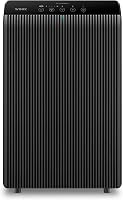
HEPA vs True HEPA: Does the Label Matter? (October 2026)
HEPA vs True HEPA is a comparison of supporting claims, not a reliable ranking of air purifiers. Choose by particle efficiency, CADR, room size and a fan setting you'll keep running.
On this page (10 sections)
- HEPA vs True HEPA: what do the labels mean?
- Why does CADR matter for room-cleaning speed?
- Who should choose the Levoit Core 300-P?
- Who should choose the Coway AP-1512HH?
- Who should choose the Winix 5510?
- Can either filter label solve odors or allergy concerns?
- How should you set up and run a HEPA purifier?
- How do you care for HEPA and True HEPA filters?
- Which HEPA vs True HEPA mistakes should you avoid?
- Which HEPA air purifier should you choose?
HEPA vs True HEPA comes down to supporting performance claims, not a rule that “True” always means better. Choose a purifier with suitable room coverage, clear particle filtration figures and a fan setting you'll keep running.
A filter can capture a high share of particles passing through it while a small fan takes too long to clean a large room. A powerful purifier also loses much of its value if you keep it switched off because of noise.
The three models below suit different routines: manual bedroom use, automatic operation and remote control. Start with our best air purifiers for different rooms and needs if you haven't yet narrowed down the room.
| Product | Best for | Filter claim | AHAM room size | Lowest stated noise | Our score |
|---|---|---|---|---|---|
| Levoit Core 300-P | small bedrooms | 99.97% at 0.1 to 0.3 microns | 222 sq ft | 24 dB | 8.8 |
| Coway AP-1512HH | automatic operation | 99.97% at 0.3 microns | 8.7 | ||
| Winix 5510 | remote control | 99.99% down to 0.01 microns | 392 sq ft | 23.5 dB | 8.6 |
HEPA vs True HEPA: what do the labels mean?
HEPA describes high-efficiency particle filtration; True HEPA wording needs the same supporting detail. The extra word does not establish airflow, room coverage or a separate whole-unit performance grade.
The EPA explanation of HEPA filters describes a HEPA filter as theoretically able to remove at least 99.97% of airborne particles measuring 0.3 microns. This describes capture by the filter, rather than how quickly a purifier cleans a room.
“HEPA-type” and “HEPA-like” wording should not be treated as proof of that efficiency. Ask for a clear capture percentage and particle size instead of assuming similar names mean equal performance.
HEPA-grade wording also needs context. A qualification tied to a particular operating mode is part of the claim, so read it alongside the percentage.
Does True HEPA beat HEPA at smaller particle sizes?
A smaller stated particle size does not establish a better purifier. Compare claims made under matching conditions before using percentages to rank filters.
Particles smaller than 0.3 microns are not automatically too small for HEPA media. Filters capture particles through several physical mechanisms, rather than working only like a kitchen sieve.
The figures for the three models here cover different particle sizes and conditions. Treat them as descriptions of each brand's filtration claim, then use room performance to narrow your choice.
For shopping, write down four items together: capture percentage, particle size, operating condition and verification or standard. A percentage separated from those details is easy to misread.
Why does CADR matter for room-cleaning speed?
CADR helps you match particle removal to room size because it describes the volume of clean air the purifier delivers. A filter percentage cannot replace that airflow measure.
Air changes per hour describe how many room volumes pass through the purifier in an hour. More frequent circulation gives airborne particles more chances to reach the filter.
A large coverage figure based on 1 air change per hour is not equivalent to a smaller room size based on several changes. Keep the time period attached whenever you compare advertised coverage.
The Levoit Core 300-P has CADR figures of 143 CFM for smoke, 153 CFM for dust and 167 CFM for pollen. Its 222 sq ft room figure is tied to 4.8 air changes per hour.
The Winix 5510 is AHAM Verifide for 392 sq ft, while Coway describes the AP-1512HH as cleaning up to 1,748 sq ft in 60 minutes. Those figures need different treatment when sizing a room.
The AHAM Verifide program provides a shared basis for comparing verified air-cleaning performance. Our guide to CADR, filters and purifier sizing explains how to use those measures.
How should you measure the space?
Measure the area the purifier will actually serve, including connected open space. Multiply room length by width for a rectangular room, and split an irregular space into smaller rectangles.
High ceilings add air volume even when the floor area stays the same. An open doorway also lets air move between spaces, so don't size a unit as though an open living area were a closed bedroom.
Our guide to calculating room size for an air purifier helps you turn room measurements into a useful buying target. Avoid assuming one unit in a hallway will clean every room equally.
Who should choose the Levoit Core 300-P?
Choose the Levoit Core 300-P for a smaller bedroom or office where you prefer manual controls. It leads these picks at 8.8 and suits someone who wants to set a steady fan speed.
Levoit states 99.97% filtration efficiency for airborne particles from 0.1 to 0.3 microns. Its separate HEPA-grade statement applies to the original filter while the purifier operates in Sleep Mode.
That qualification does not tell you to use Sleep Mode for every situation. Choose the fan setting around the room's cleaning needs and the noise you can accept.
The display lights can be switched off, and a timer offers 2-, 4-, 6- or 8-hour settings. Those controls suit a bedroom routine, although a timer isn't a substitute for regular operation while particles keep entering the room.
Skip it if automatic fan changes are a priority. The Core 300-P requires manual speed control, so choose one of the sensor-based models below if you don't want that task.
Its 8.7 x 8.7-inch footprint is also useful where floor space is limited. The unit requires 120V power and is intended only for use in the United States.
Who should choose the Coway AP-1512HH?
Choose the Coway AP-1512HH if you want automatic fan control and reminders for filter care. Its 8.7 score puts it second here, with daily convenience as its main reason to buy.
Coway's four-stage system includes a washable pre-filter, deodorization filter, bipolar device and HEPA filter. Coway states 99.97% reduction of 0.3-micron particles and ties its HEPA filter compliance with IEST-RP-CC007 to speed level 1.
Auto Mode adjusts fan speed as the pollution sensor detects changes. A colored indicator shows the sensor's assessment of the air, and you can turn that light off for sleeping.
The pre-filter cleaning and filter replacement alerts are useful if maintenance tends to slip your mind. Eco Mode is another available control, but choose your operating routine around adequate airflow.
Skip choosing this model solely for its large coverage number. The 60-minute coverage claim needs a cleaning-rate comparison before you use it to size a room with frequent particle sources.
It suits buyers who want the purifier to respond without frequent button presses. Even then, check its operation during activities that add particles rather than treating Auto Mode as complete oversight.
Who should choose the Winix 5510?
Choose the Winix 5510 for app access and a larger verified room size than the Levoit. Its 8.6 score ranks third here, but it is the more suitable choice when those needs decide the purchase.
Winix states that its True HEPA filter captures 99.99% of airborne allergens down to 0.01 microns. Its washable fine-mesh pre-filter catches larger particles, while Winix says the carbon filter reduces household odors and VOCs.
The Winix Smart app lets you control and monitor the purifier remotely. That helps if you want to check its status without walking into the room.
Its light-responsive Sleep Mode activates when the room becomes dark and returns to Auto Mode when light returns. Consider that behavior if the room stays dim during the day or you want continued stronger airflow after dark.
Skip it if a compact body is your first priority. At 11 x 15.9 x 25.2 inches, it needs more room than the Levoit, including space around its air openings.
App convenience also doesn't replace filter care. Put maintenance reminders somewhere you'll notice them even if you rarely touch the purifier itself.
Can either filter label solve odors or allergy concerns?
Choose particle filtration for airborne dust, pollen and dander, and a separate odor-control stage for gases. Neither HEPA label describes how much odor-reducing media a purifier contains or how long it will remain useful.
Coway includes a deodorization filter, and Winix includes a carbon filter. Those stages address a different job from the particle filter, so don't assume a stronger particle claim means better odor removal.
For smoke, reducing particles is only part of the task. Our guide to air purifiers for smoke explains why smoke gases and source control also matter.
For allergens, focus on the room where you spend time and keep particles from building up on surfaces. A purifier only captures material that becomes airborne and reaches its intake.
Vacuuming, damp dusting and cleaning bedding still matter. Our guide to how air purifiers work and what they cannot do covers the limits of room filtration.
An air quality light is also not proof that every pollutant is gone. Sensors respond to what they are designed to detect, so use them as operating aids rather than complete air-quality reports.
How should you set up and run a HEPA purifier?
Give the intake and outlet clear space, then use a fan speed that balances airflow with tolerable noise. A blocked purifier or one left on its lowest setting may clean too slowly for the room.
Before first use, follow the manual to check that any protective filter wrapping has been removed. Confirm the filter is seated correctly and the access cover is secure.
Choose a stable position where curtains, bedding and furniture cannot cover the openings. Keep cords out of walkways and away from pets that might chew them.
Place the unit in the room you want to clean instead of hiding it behind furniture. Our air purifier placement guide explains how to choose a useful spot around everyday obstacles.
Use a higher speed when more cleaning is needed, then reduce it if noise becomes disruptive. Published minimum sound levels describe low settings, not the noise or airflow available at every speed.
For steady particle sources, regular operation is more useful than a short burst followed by hours switched off. Close doors when you want to focus the unit on one room, while still providing suitable ventilation when needed.
How do you care for HEPA and True HEPA filters?
Care for each filter stage according to its own instructions. A washable pre-filter does not mean the HEPA or deodorization filter can also be washed.
Check the pre-filter for hair and lint, especially in homes with pets. Follow the manual's cleaning method, and let any washable part dry fully before putting it back.
Do not rinse, scrub or spray a HEPA filter unless the manufacturer explicitly permits it. Cleaning that damages the media or its fit can undermine particle capture.
Levoit recommends replacing the Core 300-P filter every 6 to 8 months and using official replacements. Actual care needs also depend on how much dust and other material reaches the filter.
Keep a record of installation and replacement dates. An indicator is a useful reminder, but it doesn't replace checking for damage, poor fit or restricted airflow.
Before buying any model, confirm you can obtain the correct replacement filters and keep up with their ongoing cost. A purifier is a recurring filter commitment, not just a one-time appliance purchase.
Which HEPA vs True HEPA mistakes should you avoid?
Avoid buying from the filter label or maximum coverage number alone. Most poor matches come from overlooking airflow, room layout or the setting used each day.
- Ranking by percentage alone: Different particle sizes and operating conditions do not make a fair direct comparison.
- Sizing for the quietest mode: Low noise is useful, but slower airflow can require a smaller room or longer operation.
- Expecting Auto Mode to catch every event: Check how the purifier responds and adjust the fan when needed.
- Using smell as a filter check: Particle capture and odor reduction are separate jobs, and many airborne particles have no smell.
- Ignoring filter fit: Use the correct replacement and seat it properly so air follows the intended path.
- Moving one unit constantly: Each room needs time with the purifier running; carrying it around does not provide steady cleaning everywhere.
Decide where the purifier will live before choosing its controls or filter wording. That makes it easier to reject a model that fits your wish list but not your room.
Which HEPA air purifier should you choose?
Choose Levoit for a small room with manual controls, Coway for automatic operation, or Winix for app access and larger verified coverage. The right HEPA vs True HEPA choice follows your room and routine.
Pick the Core 300-P if you'll set fan speeds yourself and value a compact bedroom unit. Choose the AP-1512HH if sensor-based control and maintenance alerts matter more to your daily use.
Choose the 5510 if remote control would be useful and you have space for its taller body. Account for its light-responsive Sleep Mode before making it your after-dark cleaning choice.
If none fits the room at a usable fan speed, keep looking rather than compromising for a label. Before ordering, plan the maintenance routine with our guide to changing an air purifier filter.
Frequently asked questions
Is True HEPA better than HEPA?
True HEPA is not automatically better than HEPA. Compare each purifier's particle efficiency, particle size and operating conditions, then check CADR and room coverage.
A higher filter capture percentage does not necessarily mean faster cleaning, especially if the purifier moves less air at the speed you use.
What does HEPA mean on an air purifier?
HEPA means high-efficiency particulate air filtration. The EPA describes a HEPA filter as theoretically able to remove at least 99.97% of airborne particles measuring 0.3 microns.
That describes filter capture, while the complete purifier's airflow, filter fit and fan speed affect how quickly it cleans a room.
Is HEPA-grade the same as True HEPA?
Do not treat HEPA-grade and True HEPA as interchangeable without checking their supporting claims. Look for the capture percentage, particle size and any operating-mode limits.
For example, Levoit ties the Core 300-P original filter's HEPA-grade wording to Sleep Mode, so that qualification belongs with the claim.
Does a HEPA filter remove odors?
A HEPA filter captures particles rather than gases that cause many odors. A separate activated carbon or deodorization filter addresses that different job, with results depending on the media and conditions.
Remove the odor source and use suitable ventilation instead of expecting particle filtration to handle every smell.
Should I choose CADR or the HEPA label?
Use CADR to judge room-cleaning speed and the HEPA claim to understand particle capture. Both matter, but CADR is more useful for matching a complete purifier to your room.
Compare coverage at the same cleaning rate, and remember that quieter fan settings generally deliver less clean air.