Best Air Purifiers for Home: A Size-and-Need Guide
The best air purifier for most homes among these four is the Levoit Vital 200S-P, with verified clean-air output and an extra intake for airborne pet hair. Choose Coway for care reminders, Winix for odor filtration and sleep automation, or Blueair for a lighter unit with app scheduling.
On this page (12 sections)
- What does an air purifier actually do?
- How to choose the best air purifier by room size
- Match filtration to dust, allergies, smoke or pets
- Four air purifiers and who should buy each
- How the four models differ
- Noise matters at the fan speed you will use
- Set up the purifier before judging the result
- Filters and cleaning are part of the buying decision
- HEPA labels do not replace clean-air output
- Air purifier or humidifier?
- Common buying mistakes to avoid
- Final choice: the best air purifier for your home
The best air purifier for most homes among these four is the Levoit Vital 200S-P, thanks to verified clean-air output and an extra intake for airborne pet hair. Coway, Winix and Blueair suit buyers who put more weight on maintenance reminders, sleep automation or app scheduling.
Buy for one room first. Measure the space where the purifier will run, identify the particles or odors you want to reduce, then compare airflow before choosing convenience features.
A bedroom needs a sound level you can sleep with. A pet-filled living room needs enough airflow and manageable filter care, while smoke calls for a clear distinction between particle capture and gas removal.
What does an air purifier actually do?
An air purifier moves room air through filters to reduce airborne particles and, with suitable filter media, some gases and odors. It supplements cleaning and source control.
Particle filters catch floating dust, pollen, smoke particles and pet dander. Carbon and deodorization stages address a different task: reducing some airborne gases that contribute to smells.
The EPA guide to air cleaners explains why filtration belongs alongside source control and ventilation. Remove the pollution source when possible, and bring in outdoor air when outdoor conditions make that helpful.
Read whether air purifiers work for the limits. If you are weighing the benefit against another appliance and ongoing filter purchases, start with are air purifiers worth it.
What filtration cannot fix
A purifier cannot collect dust already resting on a shelf, remove pet hair from upholstery or repair a damp wall. Vacuuming, wiping surfaces and fixing moisture problems remain separate jobs.
It also cannot tell you that a room is safe from every airborne hazard. An air-quality light reflects the unit's sensor readings, not a complete check of everything in the air.
How to choose the best air purifier by room size
Choose enough clean-air output for the room you actually use, including connected areas that remain open. A large coverage number means little without the cleaning interval behind it.
Multiply length by width to find floor area. A room measuring 12 x 15 ft has 180 sq ft; our room measurement guide also covers L-shaped spaces and open plans.
High ceilings add air volume without adding floor area. Note ceiling height alongside your measurements rather than treating every room with the same square footage as equal.
Closed doors and walls limit circulation between rooms. One purifier in a hallway cannot provide the same direct filtration as a correctly sized unit in an occupied bedroom.
Compare the best air purifiers using CADR
CADR, or clean air delivery rate, measures filtered-air output for a given particle type. Higher output lets a suitable purifier process room air more quickly.
Compare smoke with smoke, dust with dust and pollen with pollen. Also check the fan setting behind the figure, because a purifier's quietest setting will not necessarily deliver its maximum output.
For a rough planning example, a 300 sq ft room with an 8 ft ceiling holds 2,400 cubic feet of air. At 200 CFM of clean-air output, that works out to about 5 equivalent air changes per hour.
That calculation is a sizing aid, not a promise that every corner receives equal circulation. Furniture, placement and airflow between spaces affect the room.
Read coverage claims with the clock attached
A purifier described as covering a large room in 1 hour moves through that air less often than it would in a smaller room. Faster repeated cleaning requires a smaller matched space at the same output.
Winix illustrates the difference clearly: the 5510 is AHAM verified for 392 sq ft, while its broader coverage figures include 470 sq ft in 15 minutes and 1,882 sq ft in 1 hour.
Those figures describe different cleaning intervals for the same machine. Do not use the largest one to assume it will clean a large open plan as quickly as a smaller bedroom.
Our guide to air purifier CADR and room sizing explains these comparisons. For connected living areas, see the best air purifiers for large rooms.
Match filtration to dust, allergies, smoke or pets
Choose particle filtration for airborne dust, pollen, dander and smoke, then assess odor filtration separately. A high particle-capture percentage does not show how much gas a purifier can remove.
Start with the problem you can identify. Visible dust, pet smells and outdoor smoke call for different steps even when one purifier helps with several of them.
Allergies and pollen
For pollen and dander, prioritize room fit and steady particle filtration. Put the purifier where you spend long stretches, rather than moving it between rooms every few hours.
Keep pollen from building up on bedding and clothing, and limit open windows when outdoor pollen is high. Filtration cannot remove allergens embedded in a sofa or mattress.
Read do air purifiers help with allergies for practical limits, then compare the best air purifiers for allergies. Persistent symptoms deserve advice from a health professional.
Household dust
Choose enough airflow for floating dust and an accessible pre-filter for larger debris. Continue vacuuming and damp wiping, since settled particles must be removed from surfaces.
Avoid placing the intake directly against dusty curtains or loose fabric. A blocked intake reduces the air that can reach the filters.
Our air purifier for dust guide explains what filtration changes. The best air purifiers for dust narrows the choices for that concern.
Smoke particles and smoke odors
Smoke requires particle removal plus source control, with suitable carbon media for some gases and odors. A portable purifier cannot make indoor smoking safe.
For wildfire smoke, follow local guidance about outdoor air entry and concentrate filtration in an occupied room. Keep the purifier running at a useful airflow rather than choosing the quietest setting by default.
Read what an air purifier can do for smoke before comparing the best air purifiers for smoke. If gas removal is your main goal, seek clear carbon-capacity information before buying.
Pet hair, dander and odors
For pets, separate airborne dander and hair from the source of smells. Particle filtration helps with suspended material, while odor reduction depends on the gas-filter stage and ongoing cleaning.
Wash pet bedding, clean litter areas and remove accidents promptly. An odor-control filter has a harder job when the source keeps releasing more smell.
Our guide to air purifiers and pet odor explains those limits. Use the best air purifiers for pets for a more focused shortlist.
Mold and damp rooms
Fix moisture before buying a purifier for mold. Capturing airborne mold particles does not remove growth from a wall or stop it from returning.
A musty room needs a search for leaks, condensation or damp materials. Read what an air purifier can do for mold before treating filtration as the main solution.
Four air purifiers and who should buy each
The Levoit Vital 200S-P is our all-around starting point, while the other models serve more specific preferences. The order follows their site scores, with room fit taking priority over the score when you buy.
Levoit Vital 200S-P
Choose the Levoit Vital 200S-P for a busy living area or pet household where clear airflow figures matter more than a long feature list. Its traditional intake and extra U-shaped intake are designed to collect airborne pet hair without clogging.
Score: 9.2. Best for pet households.
Levoit provides AHAM-verified CADR values of 250 CFM for smoke, 254 CFM for dust and 289 CFM for pollen. These separate figures make it easier to match output to your main particle concern.
The unit measures 14.96 x 8.66 x 19.69 inches and weighs 13.2 lb. Mark out the footprint where it will stay, with additional room for intake clearance and filter access.
Levoit offers replacement filters aimed at pet allergens, smoke and other concerns. Check the exact compatible option before committing to an ongoing filter supply.
Skip it if your main goal is strong gas removal and you need a clear carbon-capacity figure to support that choice. Also size it for the whole connected room before choosing it for an open plan.
Read our Levoit Vital 200S-P review, or compare the brand's alternatives in best Levoit air purifiers.
Coway AP-1512HH
Choose the Coway AP-1512HH if you want automatic fan adjustment and clear care reminders. Its alerts cover both replacement filters and cleaning the washable pre-filter.
Score: 8.7. Best for busy routines.
The four-stage system combines that pre-filter with a deodorization filter, Bipolar Device and HEPA filter. Auto mode adjusts the fan as the air-quality sensor detects changes.
Coway describes coverage of up to 1,748 sq ft in 60 minutes. Treat that as a one-hour figure when judging room fit, especially if you want repeated cleaning in a bedroom or living room.
The colored air-quality indicator can be turned off for sleep. That suits buyers who want a visible daytime reading without keeping the light on beside the bed.
It measures 9.6 x 16.8 x 18.3 inches and weighs 12.5 lb. Leave access for pre-filter removal so routine care does not require rearranging furniture.
Skip it if app scheduling is central to your routine; Winix and Blueair provide documented app options here. Read our Coway AP-1512HH review for a closer decision.
Winix 5510
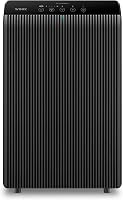
Choose the Winix 5510 for a room used through the day and night, especially if remote control and odor filtration matter. Its light sensor shifts the unit into Sleep mode when the room darkens and back to Auto mode in light.
Score: 8.6. Best for day-to-night rooms.
The system includes a washable fine-mesh pre-filter, True HEPA filter and odor-control carbon filter. Winix says the carbon stage reduces household odors from cooking, pets and smoke, along with some VOCs.
The Winix Smart App adds remote control and monitoring. This suits someone who wants to adjust the purifier without returning to the room.
The unit measures 11 x 15.9 x 25.2 inches and weighs 13.3 lb. Its height deserves attention if you plan to place it beneath a shelf.
Skip it if automatic quiet operation in a dark room conflicts with your airflow needs. Check the operating options before buying for a room that stays dim during the day.
Our Winix 5510 review covers the controls and room-fit trade-offs in more detail.
Blueair Blue 311i Max
Choose the Blueair Blue 311i Max if you want app scheduling and an easier unit to carry between suitable spaces. At 7.72 lb, it is the lightest of these four.
Score: 7.9. Best for occasional room moves.
It measures 12.5 x 12.5 x 19 inches and draws air through a 360-degree intake. Leave open space around the unit rather than pushing it tightly into a corner.
Blueair's HEPASilent system combines mechanical and electrostatic filtration. Blueair gives a CADR of 250 for smoke, dust and pollen, plus coverage of 439 sq ft in about 12.5 minutes.
The app supports scheduling, air-quality monitoring and filter-life tracking. Built-in sensors also adjust fan speed as pollution levels change.
Skip it if one movable purifier would leave another occupied room without filtration. Its lower weight makes moving easier, but it still cleans the space where it is running.
Compare the brand approaches in Blueair vs Levoit air purifiers, especially if you are weighing scheduling against Levoit's extra pet-hair intake.
How the four models differ
Choose by the feature that changes your daily use, after confirming room capacity. These differences are more useful than treating every extra control as a reason to buy.
| Model | Buyer match | Main reason to look elsewhere |
|---|---|---|
| Levoit Vital 200S-P | Pet homes wanting clear particle-output figures | Gas removal is the main concern and needs stronger supporting detail |
| Coway AP-1512HH | Buyers who want reminders for routine care | App scheduling is a priority |
| Winix 5510 | Buyers wanting remote control and day-to-night automation | A dark room needs a different operating pattern |
| Blueair Blue 311i Max | Buyers wanting scheduling and easier occasional moves | Several occupied rooms need filtration at once |
If Levoit and Coway are your finalists, read Levoit vs Coway air purifiers. For a closer comparison of automatic operation and washable pre-filters, use Coway vs Winix air purifiers.
Considering a different Levoit model for another room? Our Levoit Core 300 review helps you assess that separate option.
Noise matters at the fan speed you will use
Choose a purifier you can leave running at useful airflow. A low noise figure is helpful only when that setting also suits the room.
Winix gives the 5510 a lowest-speed sound figure of 23.5 dB. Blueair gives a range of 23 to 50 dB and identifies the Blue 311i Max as QuietMark certified.
Those numbers describe different operating conditions. Do not assume that a quiet low setting supplies the airflow used for a maximum coverage claim.
For a bedroom, decide how much fan sound and indicator light you can tolerate before comparing extras. Automatic modes can change speed during the night, which some sleepers notice more than a steady sound.
Our best quiet air purifiers focuses on sound-sensitive spaces. The best bedroom air purifiers also considers light control and nighttime use.
Set up the purifier before judging the result
Start with unwrapped filters, clear airflow and the right operating mode. A correct first setup prevents simple mistakes that can sharply limit filtration.
- Read the model's setup and clearance instructions.
- Open the filter compartment and remove any shipping bags or protective wrapping.
- Fit each filter in the required order and close the compartment properly.
- Place the unit upright on a stable surface with its intake and outlet clear.
- Route the cord where people and pets will not trip over or pull it.
- Choose the operating mode, then set up optional app controls.
Do not spray fragrance or cleaning products into the intake to freshen the room. That adds airborne material and can wet parts that should stay dry.
Choose a permanent working spot
Place the purifier in the room where you need filtration most. Leave the manual's required clearance, including space above the outlet and access for filter changes.
Avoid curtains that can drape over an intake, furniture that blocks the outlet and spots exposed to splashes. A convenient hidden corner may be a poor location if air cannot circulate.
Our guide to where to place an air purifier covers bedrooms, living rooms and open plans.
Use Auto mode as a convenience
Auto mode responds to what the sensor detects. It cannot measure every pollutant, and a low reading does not mean every odor or allergen has gone.
If quiet automatic operation leaves you concerned about airflow, review the manual's fixed-speed options. Choose a sustainable setting rather than repeatedly switching the purifier off because a higher speed bothers you.
Filters and cleaning are part of the buying decision
Check replacement availability and the care routine before buying the appliance. A purifier only remains useful if you can keep the correct filters fitted and the intake clear.
Compare the full replacement set, not just one filter stage. Note which parts are washable, which need replacing and whether the recommended replacements are easy for you to obtain.
Record the installation date when fitting a new filter. Check it sooner if airflow seems weaker, the pre-filter looks loaded or indoor conditions have been unusually dusty or smoky.
An alert is a reminder to inspect and follow the manual. It does not mean you should wash a disposable particle or carbon filter.
Wash only parts the instructions identify as washable, and let those parts dry fully before reinstalling them. Unplug the purifier before opening it for care.
Read how often to change an air purifier filter for a schedule based on use and conditions. Our Levoit air purifier cleaning guide covers the outside, intake and filter area.
HEPA labels do not replace clean-air output
Use filter design and CADR together to judge a purifier. Capture efficiency describes particles passing through a filter, while clean-air output also accounts for airflow.
A very small particle-size claim does not show how fast a unit will clean your living room. Compare room capacity at a useful cleaning interval before letting a filtration label settle the choice.
Coway uses a HEPA filter, Winix uses True HEPA and Blueair uses HEPASilent dual filtration. These names describe different systems rather than a simple ranking from best to worst.
Our HEPA vs True HEPA guide explains how to read those terms. If you prefer to avoid electrostatic or ionizing technology, check the full design and operating options before ordering.
Air purifier or humidifier?
Choose an air purifier for airborne particles and a humidifier when dry air needs added moisture. They address different conditions.
Dry-feeling air does not prove that dust is the problem, and a purifier does not add humidity. Likewise, adding moisture does not remove smoke particles or pet dander.
Some rooms may benefit from both appliances, but each needs proper care and placement. Read air purifier vs humidifier to match the appliance to the problem.
Common buying mistakes to avoid
The biggest mistake is choosing by maximum coverage alone. Keep the room, cleaning interval and usable fan speed together throughout the decision.
- Buying for an entire floor without considering doors. Treat separated bedrooms as distinct spaces rather than adding their floor areas to a hallway.
- Choosing only by the quietest mode. Confirm that useful airflow and comfortable sound can coexist in your room.
- Expecting particle filtration to remove every smell. Odor control depends on suitable media, its capacity and removal of the source.
- Blocking the intake to hide the appliance. Measure the clearance space as well as the unit itself.
- Waiting for a warning before checking filters. Inspect them as the manual directs, especially after heavy dust or smoke exposure.
- Skipping replacement planning. Identify the correct filter set before committing to the purifier.
Before ordering, write down your room dimensions, main pollutant and planned location. Those 3 details make it much easier to reject a poor fit.
For a fuller walk-through, read how to choose an air purifier. It connects airflow, filters and size in one decision.
Final choice: the best air purifier for your home
Choose the Levoit Vital 200S-P for a pet household or busy room where verified particle-output figures guide the choice. Pick the Coway AP-1512HH if care reminders will help you maintain a steady routine.
Choose the Winix 5510 when remote control, odor filtration and light-based sleep automation fit the room. Pick the Blueair Blue 311i Max when app scheduling and easier occasional moves matter more.
If none fits your measured space at the airflow you need, widen the search before buying. The best air purifier is one you can place correctly, leave running and maintain.
Use our air purifier room-size guide to settle capacity first, then choose the controls and care routine you will use.
Frequently asked questions
What is the best air purifier for most homes?
The Levoit Vital 200S-P is our all-around choice among these four because it combines verified clean-air output with an extra intake for airborne pet hair. Choose by room size first, then consider your main pollutant, the sound you can tolerate and the filter care you will keep up with.
How do I choose the right size air purifier?
Measure the room's length and width, multiply them to get square feet and compare clean-air output for that space. Check the cleaning interval behind any coverage figure, since one air change per hour is much slower than several; high ceilings and connected spaces also increase the amount of air to clean.
Do air purifiers remove dust, smoke and pet odors?
Particle filters capture airborne dust, smoke particles and pet dander, while suitable carbon filters can reduce some odors and gases. Those are separate jobs, so a high particle-capture percentage does not establish odor performance; keep cleaning surfaces, removing odor sources and using safe ventilation alongside a properly sized purifier.
Should an air purifier run all day?
Steady operation usually makes more sense than short bursts because particles keep entering the room and becoming airborne. Choose a fan speed you can leave running comfortably; auto mode offers convenience, but its sensor does not measure every pollutant, and a quiet setting may move less air than your room needs.
Is HEPA or True HEPA better?
Choose by the complete purifier's airflow, filter design and room fit rather than the words HEPA or True HEPA alone. Capture efficiency describes what happens to particles passing through the filter; CADR helps show how much clean air the unit delivers, which is more useful when comparing room-cleaning capacity.