6 Best Air Purifiers for Smoke (October 2026)
The best air purifiers for smoke include the Levoit Core 300-P for small bedrooms, the Coway AP-1512HH for automatic daily use, and the Winix 5510 for larger living rooms.
On this page (8 sections)
- How we chose air purifiers for smoke
- The best air purifiers for smoke in detail
- How to choose the best air purifier for smoke
- Which purifier fits your kind of smoke?
- How should you set up a purifier for smoke?
- How do you care for filters after smoke exposure?
- Which mistakes reduce smoke-cleaning results?
- Which air purifier for smoke should you choose?
The Levoit Core 300-P is our pick for the best air purifier for smoke in a small bedroom or office, thanks to its verified smoke-particle performance. Choose a larger model when you need to clean a larger room several times per hour.
Your first decision is which room to protect, followed by how much clean air it needs. Smoke odors matter too, but a pleasant smell and a low particle reading answer different questions.
For other room sizes and household needs, start with our air purifier size-and-need guide. Read what air purifiers can and cannot do if you're deciding what results to expect.
Our picks at a glance
-
1

-
2

-
3

How we chose air purifiers for smoke
We prioritized smoke-particle airflow, useful room-size figures and practical controls. Filter care and odor features also matter because a purifier needs to stay running and maintained through repeated smoke exposure.
Our scores reflect each model's overall fit for this guide, including room use and controls. A higher score does not mean a model moves more air than every purifier below it.
We separated particle capture from odor reduction rather than treating them as the same job. Our guide to air purifiers for smoke explains why particles, gases and settled residue need different responses.
| Product | Best for | Smoke CADR | Room coverage | Filter | Our score |
|---|---|---|---|---|---|
| Levoit Core 300-P | small bedrooms | 143 CFM | 222 sq ft at 4.8 air changes per hour | 3-stage Original Filter | 8.8 |
| Coway AP-1512HH | automatic daily use | Up to 1,748 sq ft in 60 minutes | Washable pre-filter, deodorization filter, bipolar device and HEPA filter | 8.7 | |
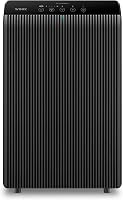
| Winix 5510 | larger living rooms | 392 sq ft AHAM verified | True HEPA and carbon filter | 8.6 | |
| Coway Mighty2 | tracking particle changes | 240 | 900 sq ft in 30 minutes | HEPA and active carbon Max2 filter | 8.1 |
| Blueair Blue 311i Max | remote room management | 250 | 439 sq ft in 12.5 minutes | HEPASilent mechanical and electrostatic filtration | 7.9 |
| Shark NeverChange HP152 | reducing filter chores | Up to 650 sq ft at one air change per hour | NeverChange HEPA filter and washable Debris Defense screens | 7.2 |
The best air purifiers for smoke in detail
Choose the model that fits your room and daily routine. The small-room leader is useful only within its limits; a larger room needs more airflow even when its purifier sits lower in the overall order.
Levoit Core 300-P: Best for small bedrooms
- Smoke CADR of 143 CFM
- AHAM verified
- 222 sq ft at 4.8 air changes per hour
- Sleep Mode at 24 dB
A small-room choice for people who want verified smoke-particle performance and manual controls. Switchable display lights suit bedroom use.
Pros
- AHAM-verified smoke CADR
- Sleep Mode and switchable display lights
- Filter check indicator
Cons
- Less airflow than the higher-CADR models here
- Manual fan control requires attention during smoke events
The Levoit Core 300-P suits a small, enclosed room where you can manage the fan yourself. Its smoke CADR is 143 CFM, with AHAM-verified coverage of 222 sq ft at 4.8 air changes per hour.
Use that frequent-cleaning figure to judge bedroom fit. The much larger 1,073 sq ft claim represents only one air change per hour, so it is not the right target for a room facing ongoing smoke entry.
Levoit gives Sleep Mode a noise level of 24 dB, and you can switch off the display lights. During a smoke event, choose the highest fan setting you can tolerate rather than assuming the quietest setting supplies the rated airflow.
Skip it for a large living area or automatic response. This model requires manual fan-speed changes, so it suits someone who will check conditions and adjust it.
Levoit recommends replacing its Original Filter every 6 to 8 months, though heavy smoke can call for earlier attention. Its performance and coverage figures apply to Original Filters, making the correct replacement part of the buying decision.
Coway AP-1512HH: Best for automatic daily use
- Four-stage filtration
- Auto Mode adjusts fan speed
- Air-quality light can be turned off
- Filter and pre-filter alerts
Automatic fan changes and separate care alerts suit people who want help managing daily operation. Its deodorization filter adds odor control alongside particle filtration.
Pros
- Auto Mode responds to air quality
- Air-quality light can be turned off
- Alerts cover filter replacement and pre-filter cleaning
Cons
- One-hour coverage is a poor guide to frequent air cleaning
- No smoke CADR supplied for direct comparison here
The Coway AP-1512HH suits people who want automatic daily operation without giving up a visible air-quality indicator. Auto Mode changes fan speed as the sensor detects changes, while the indicator light can be turned off for sleep.
Its four-stage system combines a washable pre-filter, deodorization filter, bipolar device and HEPA filter. Coway says it reduces fine particles, VOCs and odors, giving it a broader role than particle capture alone.
The care alerts are a useful distinction: they cover both filter replacement and pre-filter cleaning. That helps if you tend to forget the washable layer until it looks heavily coated.
Skip it if you need a clearly stated smoke CADR to size your room. The available coverage figure is up to 1,748 sq ft in 60 minutes, which should not be read as a frequent-cleaning recommendation for a space that large.
Pick it for its controls and care reminders once you've confirmed room suitability. Our Coway AP-1512HH review covers the model in more detail.
Winix 5510: Best for larger living rooms
- AHAM verified at 392 sq ft
- Washable fine-mesh pre-filter
- Carbon filter for odors and VOCs
- Auto Mode and app support
A larger-room option with remote control, automatic fan adjustment and a washable pre-filter. Winix says its carbon filter reduces smoke odors and other household odors.
Pros
- AHAM-verified room-size rating
- App control and automatic fan adjustment
- Washable pre-filter
Cons
- Larger headline coverage uses slower cleaning intervals
- Darkness triggers quieter Sleep Mode
The Winix 5510 is a practical larger-room choice for someone who wants automatic fan changes and remote control. Its AHAM-verified room rating is 392 sq ft, a more useful starting point than its larger one-hour coverage claim.
Winix pairs a True HEPA filter with an odor-control carbon filter and washable fine-mesh pre-filter. The carbon stage is intended to reduce household odors and VOCs, including smoke odors, while the pre-filter catches larger debris.
App support lets you monitor and control the purifier without walking over to it. That suits a shared living room where you may want to change settings from another part of the home.
Skip it if darkness-triggered quiet operation conflicts with your plans. The light sensor activates Sleep Mode when the room darkens, so check the operating controls before relying on overnight smoke cleanup.
Quiet operation can be welcome in ordinary use, but sustained airflow matters during pollution events. Our Winix 5510 review explains its features and room-use tradeoffs.
Coway Mighty2: Best for tracking particle changes
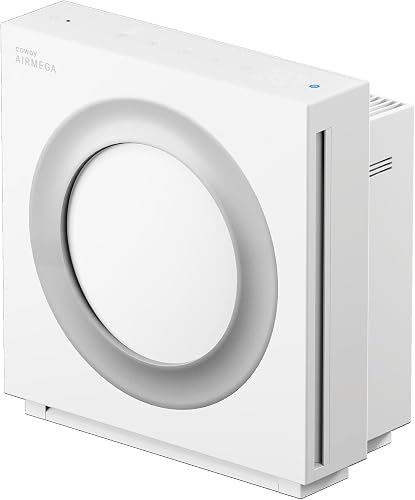
- Smoke CADR of 240
- PM1, PM2.5 and PM10 sensor
- Numerical air-quality display
- Slide-out washable pre-filter
Numerical particle readings suit people who want more detail than a colored light. Its slide-out pre-filter and remaining-life display make routine care easier to plan.
Pros
- Numerical particle readings
- Smart Mode adjusts airflow
- Pre-filter slides out without opening the front cover
Cons
- Light sensor triggers Sleep Mode in darkness
- Heavier than the AP-1512HH
The Coway Mighty2 suits people who want to follow particle changes numerically. Its sensor covers PM1, PM2.5 and PM10, with a number display alongside the colored indicator.
Its smoke CADR is 240, and Coway gives coverage of 900 sq ft in 30 minutes. Treat that coverage as a cleaning interval, rather than assuming it means frequent hourly air changes throughout a large open floor.
Maintenance access is a reason to choose this model. The washable pre-filter slides out without opening the front cover, and the display tracks remaining life for the pre-filter and combined HEPA and active-carbon Max2 filter.
Smart Mode adjusts airflow, with Eco Mode when the air is clean and light-triggered Sleep Mode in darkness. The extra readings are useful for watching trends, but they do not measure every gas in smoke.
Skip it if you mainly want a light unit to carry around. At 15.2 lb, it is heavier than the AP-1512HH at 12.5 lb, even though its hidden handles help with moving it.
Blueair Blue 311i Max: Best for remote room management

- Smoke CADR of 250
- App scheduling and filter-life tracking
- HEPASilent dual filtration
- QuietMark-certified operation
App scheduling and filter tracking suit people who want to manage a room remotely. It has the highest supplied smoke CADR among the three models with figures available here.
Pros
- Smoke CADR of 250
- App tracks air quality and filter life
- Automatic fan adjustment
Cons
- Upper end of the stated noise range is 50 dB
- HEPASilent combines mechanical and electrostatic filtration
The Blueair Blue 311i Max suits people who want app scheduling and remote room management. Its smoke CADR of 250 is the highest of the three supplied smoke CADR figures in this comparison.
Blueair rates it for 439 sq ft in 12.5 minutes. That frequent-cleaning reference is more useful for smoke planning than the much larger area attached to its one-hour figure.
HEPASilent combines mechanical and electrostatic filtration, with sensors that adjust fan speed as pollution rises. Choose it if you're comfortable with that combined approach; skip it if you specifically want mechanical filtration alone.
The app lets you monitor air quality, set schedules and track filter life. Use scheduling for routine convenience, but avoid creating long off periods while smoke continues to enter the home.
Blueair gives a noise range of 23 to 50 dB and QuietMark-certified operation. Expect the sound to change with fan speed, and plan for a faster setting to be more noticeable during a smoke event.
Shark NeverChange HP152: Best for reducing filter chores

- 650 sq ft at one air change per hour
- Real-time air-quality display
- Long-lasting HEPA filter design
- Washable debris screens
A compact option for simpler routine care, with washable debris screens and a long-lasting filter design. Its scented odor cartridge makes it a poor match for people who avoid added fragrance.
Pros
- Washable debris screens
- Air-quality and filter-life displays
- Dimmable lights
Cons
- Coverage is based on only one air change per hour
- Odor Neutralizer releases a scent
The Shark NeverChange HP152 suits buyers who want accessible care features in a compact unit. Its washable Debris Defense screens can be removed for cleaning, and the panel shows filter life and measured air quality.
Shark promotes the HEPA filter as lasting up to 5 years. Treat that as a conditional lifespan claim, especially if smoke exposure is frequent, and keep inspecting and maintaining the unit.
Its coverage is 650 sq ft at one air change per hour. Skip it for frequent smoke cleanup across a room that large, since one hourly pass is a slow cleaning rate for this job.
The included Odor Neutralizer cartridge releases a scent, so this is also a poor match if you avoid added fragrance. Scent should never be used to judge how much smoke pollution remains.
The display needs careful interpretation too. Shark's 100% clean-air reading means particles from PM1.0 to PM10 are at or below the sensor's detection limit; it does not mean every pollutant is absent.
How to choose the best air purifier for smoke
Choose by room volume and smoke CADR first, then decide which controls and care features you'll use. Extra displays cannot make up for too little airflow in the room you want to clean.
What smoke CADR does the best air purifier for smoke need?
A useful planning target is enough clean airflow for about five air changes per hour in an enclosed room. Air changes describe the equivalent room volume passing through filtration, not a promise that every particle disappears after one pass.
For an 8-foot ceiling, a smoke CADR in CFM of roughly two-thirds of the room's square footage gives about five hourly air changes. A 300 sq ft room therefore calls for roughly 200 CFM at the operating speed that delivers it.
For another ceiling height, multiply floor area by ceiling height and your target hourly air changes, then divide by 60. This accounts for the extra air in a tall room instead of relying on floor area alone.
Use the room's actual boundaries. An open doorway into a hall or kitchen adds air movement beyond the measured space, which is one reason a smaller enclosed room is easier to manage.
These calculations are planning tools, and rated airflow may require a louder setting than you'll use overnight. Our guide to air purifier CADR and sizing explains how to compare airflow and room coverage.
Why can a large coverage claim be misleading?
A large coverage figure can describe only one air change per hour. That is a different job from cleaning the same room's air several times each hour while outdoor smoke keeps finding its way inside.
Compare the full statement: area, cleaning time and air-change basis. Avoid putting one model's one-hour area beside another model's frequent-cleaning area and choosing the larger number.
Buying some airflow headroom can give you more room to adjust fan speed. It does not guarantee that a low setting will clean well enough, so choose your room and operating speed together.
How much should odor control affect your choice?
Prioritize particle removal, then look for carbon or deodorization filtration if smell is also a concern. Carbon can capture some gases, but its useful capacity depends on the filter and the substances passing through it.
There is not enough information here about carbon quantity or gas-removal capacity to rank these models by lasting smoke-odor control. Choose the named odor features for that added role without assuming they provide complete gas protection.
Persistent cigarette smoke in fabrics and walls needs source removal and cleaning too. A purifier can work on airborne pollution while it runs, but it cannot wash curtains or remove residue from a sofa.
Which purifier fits your kind of smoke?
For wildfire smoke, prioritize frequent particle cleaning in one enclosed room. For indoor smoke, stopping the source is the first step, followed by filtration and any needed surface cleaning.
Outdoor wildfire smoke entering the home
Set up the room you can keep most separate from incoming smoke. Choose a purifier for that room instead of stretching one unit across an entire open home.
A bedroom may be the most useful choice if you spend many hours there. A larger living room can make more sense during the day, provided the purifier has enough airflow for its volume.
Cooking smoke and recurring kitchen odors
Use a range hood that vents outdoors when available, and reduce smoke at the source. Place the purifier away from the stove, heat and splashes, with clear airflow into the adjoining room.
Repeatedly burning food or overheating oil calls for a change in cooking practice. A carbon filter can help with some remaining odors, but grease buildup and settled residue still need cleaning.
Cigarette smoke and lingering residue
Keep smoking outdoors and away from doors and windows. Filtering an indoor smoking room leaves an ongoing pollution source and residue that the purifier cannot remove.
For an old smoke smell after the source is gone, combine particle filtration with cleaning affected surfaces and fabrics. Added fragrance may change the smell without removing the cause.
How should you set up a purifier for smoke?
Set it up before smoke arrives, with the filter unpacked and airflow clear. A few minutes spent on placement and controls can prevent running a blocked or poorly configured purifier through the whole event.
- Unpack the filter. Check for protective wrapping inside the unit, even when the filter arrives installed.
- Choose the room. Favor the space where you'll spend the most time and can reasonably limit smoke entry.
- Clear the airflow path. Follow the manual's intake and outlet clearances rather than pushing the unit behind furniture.
- Learn the controls. Check manual speeds, automatic behavior, light settings and any sleep response before relying on them.
- Plan sustained operation. Use the highest speed you can tolerate during smoke exposure, then review conditions before reducing it.
A particle sensor can help you see changes, but Auto Mode responds only to what the sensor detects. If you know smoke is entering, do not rely solely on a reassuring color or an automatic slowdown.
Avoid aiming an outlet straight into a nearby obstruction. A unit beside heavy curtains or under a crowded desk can have room to stand while still lacking room to move air.
Our guide to where to place an air purifier explains practical layouts. If dust is another concern, see what to look for in an air purifier for dust.
Follow local public-health guidance during wildfire events, including instructions about ventilation and evacuation. Particle filtration does not remove carbon monoxide or replace a working carbon monoxide alarm.
How do you care for filters after smoke exposure?
Inspect filters more often during heavy smoke, and follow the model's care instructions. A calendar reminder is useful, but the amount of pollution passing through the unit also affects when filters need attention.
Clean washable pre-filters or debris screens as directed, then let them dry fully before reinstalling them. Do not assume the main particle filter or carbon stage is washable because an outer screen is.
Check for blocked intake grilles, a heavily loaded filter or airflow that has dropped despite the same fan setting. Inspect these before assuming a higher speed alone will solve the problem.
Persistent odor can be another reason to inspect the filter system. Particle-filter condition and odor-filter capacity are separate concerns, so a filter can still catch particles after its odor control becomes less useful.
Confirm the correct replacement filter before you buy the purifier, especially if you expect a long smoke season. Our air purifier filter replacement guide explains when care reminders and actual conditions call for different timing.
Which mistakes reduce smoke-cleaning results?
The most common mistakes are too little airflow, too much open space and stopping too soon. Better controls help with operation, but room setup and sustained use decide how much work a purifier can do.
- Sizing by the largest coverage number: Use the cleaning interval attached to that area.
- Running the quietest setting all day: Low noise does not mean maximum smoke-particle airflow.
- Moving one unit between many rooms: Each room loses active filtration while the unit is elsewhere.
- Switching off when the smell fades: Odor and airborne particle levels do not always rise and fall together.
- Trusting a clean-air display completely: Sensors have detection limits and do not measure every smoke pollutant.
- Leaving dirty screens in place: Debris buildup can restrict the airflow you're relying on.
- Using scent as a cleanup measure: Fragrance does not establish that particles or gases have been removed.
Which air purifier for smoke should you choose?
Choose the best air purifier for smoke for the room you can actually manage. For a small enclosed bedroom, pick Levoit Core 300-P if you're willing to set the fan speed yourself.
For a larger living room, favor Winix 5510 for its verified room rating and remote controls. Choose Coway AP-1512HH for automatic daily use, or Mighty2 when numerical particle trends and easier pre-filter access matter more.
Blueair Blue 311i Max suits app scheduling and remote monitoring, with strong supplied smoke airflow. Reserve Shark HP152 for buyers who value its care features and accept its slower stated coverage basis and scented cartridge.
Before ordering, settle on the room, the fan setting you'll tolerate and the replacement filter you'll need. If you're also weighing another type of indoor-air device, our air purifier vs humidifier guide explains which job each one does.
Our top 3 picks at a glance
-
1
-
2
-
3
Frequently asked questions
What is the best air purifier for wildfire smoke?
The Levoit Core 300-P is our small-room pick, while the Winix 5510 suits a larger room with automatic controls; choose by room size and frequent air cleaning, rather than the largest coverage claim. During wildfire smoke, keep the purifier running and follow local guidance about limiting outdoor smoke entry.
Does a HEPA air purifier remove smoke?
A HEPA filter captures airborne smoke particles, but it does not remove every smoke gas or clean residue from surfaces; carbon can help reduce some odors and gases. Use filtration alongside source control, and remember that a room smelling better does not prove that all smoke pollutants are gone.
What smoke CADR should I look for?
Choose enough smoke CADR to clean your actual room several times per hour; for a room with an 8-foot ceiling, roughly two-thirds of its floor area in CFM provides about five air changes per hour. Higher ceilings, open doorways and quieter fan settings call for more airflow or a smaller enclosed room.
Where should I put an air purifier during a smoke event?
Put it in the enclosed room where you spend the most time, with the intake and outlet clear of furniture and curtains; follow the manufacturer's clearance instructions and keep it away from heat and splashes. Our guide to where to place an air purifier explains practical room layouts.
Can an air purifier make a room smoke-free?
No air purifier can guarantee a smoke-free room while smoke continues to enter; it can reduce airborne particles, but it cannot remove every gas or clean smoke residue from walls and furniture. A clean-air display measures only what its sensor detects, so it is not proof of complete protection.