Air Purifiers for Smoke: What They Can and Cannot Do
An air purifier for smoke can reduce airborne smoke particles when its smoke CADR fits the room and it runs continuously during smoky conditions. Choose for particle removal first, add carbon for odor concerns, and control the smoke source.
On this page (9 sections)
- What can an air purifier do about smoke?
- Smoke particles and smoke gases need different filters
- How should you size an air purifier for smoke?
- What can an air purifier not do about smoke?
- How should you use a purifier during wildfire smoke?
- Does an air purifier help with cooking or cigarette smoke?
- Where should you put the purifier, and when should you change its filter?
- Which smoke-purifier mistakes should you avoid?
- Which air purifier for smoke should you choose?
An air purifier for smoke can reduce airborne smoke particles when its airflow fits the room and you keep it running. Choose particle-cleaning capacity first, then consider odor filters, fan noise and upkeep.
For wildfire smoke, start with one room you can keep closed and comfortable. For cooking or cigarette smoke, stopping the source matters more than adding extra filter features.
What can an air purifier do about smoke?
A correctly sized purifier lowers airborne smoke particles by drawing room air through a filter. How quickly it helps depends on airflow, room size, filter condition and the amount of new smoke entering.
Smoke contains both particles and gases, so removing particles does not remove every part of the problem. A clearer room or weaker smell does not prove the air is safe.
The EPA guide to home air cleaners explains why filtration belongs alongside source control and ventilation when outdoor air is clean. Our guide to what air purifiers can and cannot do covers their wider limits.
Coway AP-1512HH: for automatic everyday operation
The Coway AP-1512HH suits buyers who want automatic fan control and separate particle and deodorization filters. Its four stages include a washable pre-filter, deodorization filter, Bipolar Device and HEPA filter.
Coway says the HEPA stage reduces 99.97% of particles at 0.3 microns. Auto mode adjusts the fan using an air-quality sensor, while filter alerts prompt replacement and pre-filter cleaning.
Its air-quality light can be switched off for sleep. That makes it worth considering if a bright display bothers you but you still want automatic operation.
Skip it if remote app control or a numerical particle display is central to your choice. The Winix and Mighty2 below address those needs more directly.
For more models chosen around this need, see our best air purifiers for smoke.
Smoke particles and smoke gases need different filters
Particle filters capture particles; carbon targets some gases and odors. Prioritize enough particle-cleaning airflow before using odor features to narrow your choices.
Carbon capacity matters, so the presence of a carbon filter alone is not a reason to expect lasting odor control. Smoke CADR measures particle cleaning, not gas removal.
Don't rank these models by their smallest advertised particle size alone. Those claims do not tell you how much filtered air reaches your room each minute.
What matters in an air purifier for smoke?
The key buying checks are smoke CADR, room size and usable fan speed. For odor concerns, also look for a carbon stage and check replacement-filter availability before buying.
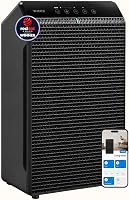
The Winix 5510 suits buyers who want app control alongside True HEPA and an odor-control carbon filter. Winix identifies it as AHAM Verified for 392 sq ft, a more useful starting point than its much larger one-hour coverage figure.
Its washable mesh pre-filter catches larger debris, and the Winix Smart App supports remote control and monitoring. Those features fit a living room where you want to manage the purifier without walking over to it.
Skip it if you need a shorter unit for your chosen spot: it stands 25.2 inches tall. Also note that darkness triggers Sleep mode, so check its controls before relying on automatic operation during overnight smoke.
How should you size an air purifier for smoke?
Choose using tobacco smoke CADR and the room's size, rather than the biggest coverage number on the box. A claim based on one hour represents fewer air changes than cleaning the same space several times per hour.
Measure the room's length and width, then account for ceiling height and connected space. An open doorway into a hall or kitchen increases the air the purifier must handle.
Our air purifier CADR guide explains airflow and room matching. Use the room-size calculation guide before comparing machines, especially for high ceilings or open layouts.
Coway Mighty2: for visible particle changes
The Coway Mighty2 suits buyers who want numerical air-quality feedback and easy pre-filter access. It has a smoke CADR of 240 and combines HEPA with active carbon in its Max2 filter.
Its laser sensor tracks PM1, PM2.5 and PM10, giving more detail than a color light alone. The washable pre-filter slides out without opening the front cover, and the display shows remaining filter life.
That combination helps if you want to watch particle changes while keeping routine care simple. Skip it if you mainly want remote app control, and don't use its particle display to judge smoke gases.
Blueair Blue 311i Max: for app-managed living spaces
The Blueair Blue 311i Max suits buyers who want app scheduling and monitoring in a bedroom, office or living room. Its smoke CADR is 250, close enough to the Mighty2 that controls and placement deserve more attention than that small difference.
Blueair states a noise range of 23 to 50 dB. Compare the sound you can tolerate during use, since a low-speed noise figure does not describe full-speed operation.
Its 360-degree intake needs clear space around the unit. Skip it if the only available location is wedged between furniture, or if smoke odor is your main reason for buying and you need clear carbon-capacity information.
What can an air purifier not do about smoke?
A purifier cannot stop a fire, remove settled residue or make an unsafe building safe. It also does not replace a carbon monoxide alarm.
Particles on walls, floors, upholstery and clothing need cleaning. A purifier can capture material that remains airborne, but it cannot pull old smoke residue out of a sofa.
Continued indoor smoking can add pollution faster than a room purifier removes it. Moving the unit closer does not turn indoor smoking into a safe activity.
How should you use a purifier during wildfire smoke?
Run it continuously in one closed room, using the highest fan speed you can tolerate. Start before outdoor smoke becomes heavy when you have advance notice.
Before first use, remove any filter packaging and seat the filters as the manual directs. Place the unit on a stable surface, keep vents clear and route the cord away from walking paths.
Keep windows and doors closed when indoor temperature and official guidance allow. Avoid adding particles with candles, smoking or unnecessary frying.
The EPA’s indoor air filtration guidance recommends proper sizing and warns against air cleaners that produce ozone. Check the manual for any ionization or electronic-cleaning controls when comparing operating modes.
If the room becomes dangerously hot or authorities advise leaving, follow that guidance. Filtration is not a reason to stay in an unsafe place.
Does an air purifier help with cooking or cigarette smoke?
A purifier can reduce airborne particles from both sources, but preventing indoor smoke comes first. Use a kitchen exhaust fan that vents outdoors, and keep cigarette smoking outside.
For occasional cooking smoke, run the purifier during cooking and afterward while the room clears. Keep it away from direct grease splashes, heat and steam.
Ventilate when outdoor air is clean. During a wildfire event, opening windows may bring in more particles, so check local conditions before airing out the room.
Where should you put the purifier, and when should you change its filter?
Place the purifier where air can reach its intake and leave its outlet freely. Follow the manual's clearance instructions and use our air purifier placement guide for room layouts.
Check filters more often during smoke events rather than waiting only for a calendar reminder. Heavy smoke can shorten useful filter life, and odor-control material can lose capacity separately from the particle filter.
Wash only parts the manual identifies as washable, then let them dry fully before reinstalling. Don't wash a HEPA or carbon filter unless the manufacturer specifically permits it.
Our guide to how often to change an air purifier filter explains maintenance signs. Check replacement-filter cost and availability before choosing a model you expect to run often.
Which smoke-purifier mistakes should you avoid?
Avoid undersizing the unit, blocking airflow and using low speed by default. Those choices reduce how much room air gets filtered during smoky conditions.
- Don't expect one unit to clean several closed rooms through walls and doors.
- Don't treat a green sensor light as proof that smoke gases are gone.
- Don't wait for a strong odor before checking a heavily used filter.
- Don't rely on an hourly coverage claim without checking the room size and cleaning rate behind it.
Auto mode is useful for daily changes, but check how your chosen model behaves in darkness. Quiet or energy-saving modes may not provide the airflow you want during a smoke event.
Which air purifier for smoke should you choose?
Choose an air purifier for smoke by room fit first, then controls and upkeep. If none fits your room at a fan speed you'll use, change the room plan or compare a larger unit.
Pick the Coway AP-1512HH for automatic operation with a light you can switch off. Choose the Winix 5510 when app control and a clearly stated AHAM room figure guide your decision.
Pick the Coway Mighty2 for a numerical particle display and easy pre-filter access. Choose the Blueair Blue 311i Max for app scheduling where you can leave space around its intake.
For other room sizes and household needs, continue with the BonnyNest air purifier guide.
Frequently asked questions
Do air purifiers remove wildfire smoke?
A correctly sized air purifier can reduce airborne wildfire smoke particles inside a room. Keep doors and windows closed when indoor temperature allows, and run it continuously during smoky conditions; it cannot remove every gas, prevent smoke from entering or replace official advice to leave an unsafe area.
Does a HEPA filter remove smoke smell?
A HEPA filter captures particles rather than the gases responsible for much of a smoke smell. Activated carbon may reduce some odors, but its capacity depends on the material and amount used; smoke residue in fabrics and on surfaces also needs cleaning, even after airborne particles fall.
Should an air purifier run all day during wildfire smoke?
Continuous operation helps keep filtering particles as outdoor smoke enters, provided the manufacturer allows it. Use the highest fan speed you can tolerate rather than relying on a quiet setting throughout the event; check filters often, keep vents clear and follow the manual for cleaning and replacement.
Where should I place an air purifier for smoke?
Place it in the room where people spend the most time, with clear space around the intake and outlet. Follow the manual's wall-clearance instructions and keep curtains away from vents; choose a stable spot with a safe cord route, rather than hiding the purifier behind furniture.