Air Purifier for Dust: What to Look For
Choose an air purifier for dust by matching its dust CADR to your room, then checking filter care and noise at a useful fan speed. It captures airborne particles, so keep vacuuming and damp dusting to remove dust that has settled.
On this page (9 sections)
- Can an air purifier remove dust from a room?
- What dust CADR should an air purifier have?
- Does filter type matter for household dust?
- Why does a pre-filter help in a dusty home?
- Are long-life filters useful for dust control?
- How much does noise matter for dust control?
- Where should you set up an air purifier for dust?
- What care and use mistakes should you avoid?
- Which air purifier for dust should you choose?
Choose an air purifier for dust with enough dust CADR for your room and a fan speed you'll keep running. Filter care, clear airflow and noise matter more than a large coverage number on its own.
A purifier catches floating particles, so pair it with vacuuming and damp dusting. It won't remove the dust already coating a shelf.
For a shorter product shortlist, see our best air purifiers for dust. Our broader home air purifier guide covers other needs such as smoke, pets and bedrooms.
Can an air purifier remove dust from a room?
An air purifier can reduce airborne dust, but it cannot pull settled dust off furniture or floors. Particles must travel through its intake to reach the filter.
Larger debris may settle quickly, while smaller particles can stay suspended longer. You may still see dust on surfaces even when the purifier is capturing airborne material.
The EPA's guide to air cleaners recommends filtration alongside source control and ventilation where practical. Portable units cannot remove every indoor pollutant.
Start with the source: use entry mats, remove dusty shoes and damp-wipe surfaces instead of brushing dust into the air. Clean bedding and vacuum rugs regularly so daily activity stirs up less material.
What dust CADR should an air purifier have?
Choose a dust CADR that fits the whole connected room, not just the space around your chair. CADR measures how much filtered air a purifier supplies each minute.
The EPA's sizing table pairs 200 sq ft with a minimum CADR of 130 CFM and 400 sq ft with 260 CFM. Those figures assume an 8 ft ceiling.
Multiply room length by width to find the floor area. Include an adjoining open dining area, and allow extra capacity for high ceilings or running below the highest fan speed.
Our room-size calculation guide helps with measuring. The air purifier CADR guide explains how dust, smoke and pollen figures differ.
Coverage also needs a time frame. Cleaning a room once per hour provides less frequent filtration than circulating its air several times per hour, even when both claims use the same square footage.
Which air purifier for dust suits a larger room?
The Levoit Vital 200S-P suits buyers who want more dust airflow than a compact bedroom unit provides. Its AHAM-verified dust CADR is 254 CFM.
That is close to the EPA's 400 sq ft sizing example, so plan around a room of roughly that scale with a standard ceiling. Levoit's advertised maximum of 1,875 sq ft should not be read as equivalent frequent cleaning across that entire area.
A traditional inlet plus a U-shaped inlet gives airborne hair another route into the purifier. That makes this a useful option for a living area where pets and daily activity stir up dust.
Choose it when room size takes priority over a small footprint. Skip it for a tight bedside space or if you expect one portable unit to handle several closed rooms.
Does filter type matter for household dust?
Choose particle filtration and sufficient airflow together. A fine filter needs enough air passing through it to make a useful difference across the room.
A capture percentage describes particles passing through the filter, not the share of dust removed from your entire home. Compare CADR and room size before treating one filter percentage as the deciding factor.
Our guide to HEPA and True HEPA labels explains the terms. For dust alone, prioritize particle capture; odor-control features address a different need.
The Levoit Core 300-P suits a small bedroom or office where you want simple manual controls. Its AHAM-verified dust CADR is 153 CFM, and Levoit gives 4.8 air changes per hour in 222 sq ft with its Original Filter.
Its display lights turn off, which helps beside a bed. The quiet sleep setting is useful overnight, but plan to use a stronger speed when you need more airflow.
Skip this model if automatic fan adjustment is a priority: it has no Auto Mode. Its 1,073 sq ft coverage figure represents one air change per hour, so it is a poor match for frequent cleaning throughout a large open room.
Why does a pre-filter help in a dusty home?
A pre-filter catches hair and larger debris before they reach the finer filter. Keeping that first layer clear helps air move through the unit.
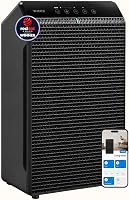
The Winix 5510 suits a busy living area where you want automatic fan control and a washable fine-mesh pre-filter. Its AHAM-verified room size is 392 sq ft.
It also has True HEPA and carbon filters, an air-quality indicator and Winix Smart App support. Auto Mode adjusts fan speed using its air-quality sensor, reducing the need for frequent manual changes.
Choose it if you'll keep up with pre-filter care and value remote control. Skip it if a compact bedside footprint matters most: it stands 25.2 inches tall.
Its light-driven Sleep Mode activates when the room darkens. If you want steady airflow in a dark room, check the control instructions before choosing your operating routine.
Are long-life filters useful for dust control?
Long-life filters can reduce replacement work, but they still depend on regular care. A long service claim does not make the purifier maintenance-free.
The Shark NeverChange HP152 suits someone who wants accessible debris screens and a filter-life display. Its removable screens can be vacuumed, wiped or rinsed as directed.
Shark advertises up to 5 years of main-filter life. Follow the care instructions and filter-life display rather than assuming a heavily dusty room will always reach that interval.
Its 650 sq ft coverage claim is based on one air change per hour. Choose it for a smaller enclosed space rather than expecting frequent air cleaning across that maximum area.
Skip it if the included scent-releasing Odor Neutralizer Cartridge conflicts with your preference for an unscented room. Also, its “Clean Air 100%” display means measured particles are below the sensor's detection limit, not that every pollutant is gone.
How much does noise matter for dust control?
Choose a purifier you can tolerate at a useful fan speed, since an uncomfortable setting often leads to the unit being switched off. The quietest mode usually moves less air than higher settings.
The Winix 5510 runs at 23.5 dB on its slowest speed. That figure and the Core 300-P's sleep figure describe specific modes, so the small difference does not establish which is quieter at equal airflow.
Run a stronger setting while the room is empty if higher airflow bothers you. Return to a comfortable setting when you come back, especially in a bedroom.
For more sleeping-room options, see our quiet air purifier picks.
Where should you set up an air purifier for dust?
Put it inside the room you want to clean, with open intake and outlet space. Follow its clearance directions instead of hiding it behind furniture or curtains.
Before the first use, unplug the unit and check whether the filter has protective packaging that needs removing. Seat the filter correctly, close the panel and route the cord away from foot traffic and pets.
Choose a stable position where bedding, loose fabric and nearby objects cannot block airflow. Our air purifier placement guide covers choosing a permanent spot.
Keep expectations local: a hallway unit cannot reliably clean bedrooms behind closed doors. Prioritize the room where you spend the most time if you are buying only one.
What care and use mistakes should you avoid?
Keep intake screens clear and clean only the parts approved for cleaning. A washable pre-filter does not mean the main particle filter can be washed too.
Check the first filter layer regularly, especially after dusty chores. Let any rinsed part dry fully before reinstalling it, following the model's directions.
Levoit recommends replacing the Core 300-P filter every 6 to 8 months. For other models, follow their own schedules and indicators rather than borrowing that interval.
Our guide to changing an air purifier filter explains when to inspect it. Check replacement-filter availability before buying so routine care is easy to maintain.
Avoid running the purifier only after dust becomes visible, using the lowest speed regardless of room size, or treating a sensor reading as proof that surfaces are clean. Steady filtration and physical cleaning handle different parts of the job.
Which air purifier for dust should you choose?
Choose an air purifier for dust by room fit first, then controls and care. These four options suit different routines:
- Levoit Vital 200S-P: choose it for greater dust airflow in a larger enclosed room.
- Levoit Core 300-P: choose it for a small bedroom or office with manual controls.
- Winix 5510: choose it for automatic fan adjustment and a washable pre-filter in a busy living area.
- Shark NeverChange HP152: choose it for accessible debris screens and less frequent main-filter replacement work.
Before ordering, confirm where it will stand and how you'll maintain it. Use our best air purifiers for dust guide to narrow the model choice once you know your room size.
Frequently asked questions
Do air purifiers really remove dust?
Yes, an air purifier captures dust that passes through its filter while airborne. It cannot collect dust already sitting on shelves, furniture or floors.
Keep vacuuming and damp dusting, and reduce incoming dirt at doors so the purifier has less material to handle.
What CADR should an air purifier have for dust?
Match dust CADR to the full room area, including connected open space. EPA guidance pairs 200 sq ft with at least 130 CFM and 400 sq ft with 260 CFM for an 8 ft ceiling.
Allow extra capacity for taller ceilings and lower fan speeds.
Should I run an air purifier all day for dust?
Regular operation gives a purifier more chances to capture dust as it becomes airborne. Choose a sustainable fan speed and follow the model's operating instructions.
Use a higher speed during dusty tasks when practical, then return to a comfortable setting rather than switching it off.
Where should I place an air purifier for dust?
Place it in the room you want to clean, with clear space around the intake and outlet. Follow the model's clearance instructions and avoid curtains, furniture or other objects that block airflow.
A unit in a hallway cannot reliably serve several bedrooms behind closed doors.