7 Best Air Purifiers for Large Rooms (October 2026)
The best air purifiers for large rooms include the Levoit Vital 200S-P for busy pet households, the Winix 5510 for remote room monitoring, and the Winix 5520 for limited floor space.
On this page (9 sections)
- How we chose air purifiers for large rooms
- Compare the best air purifiers for large rooms
- The best air purifiers for large rooms in detail
- How should you size a purifier for your large room?
- Which features matter for your household?
- Where should you put a large-room air purifier?
- How do you keep airflow strong over time?
- Which mistakes should large-room buyers avoid?
- Which is the best air purifier for your large room?
The Levoit Vital 200S-P is the best air purifier for large rooms for most buyers in this comparison, especially homes with pets. Choose the Levoit Core 600S-P or Blueair Blue 211i Max when a larger connected space makes airflow your first priority.
Start with the area you use, then compare how often each purifier can refresh its air. A model advertised for thousands of square feet may serve a much smaller room when you want several air changes each hour.
Use our air purifier size and CADR guide and guide to calculating room area before choosing. They help turn a broad coverage claim into a useful sizing decision.
Our picks at a glance
-
1

-
2

-
3
How we chose air purifiers for large rooms
We compared airflow, cleaning intervals, filtration, controls and physical fit to find useful options for different large-room layouts. A pet-filled living room, a shared office and a wide open family room call for different choices.
We gave weight to clear sizing information and features that support regular use, such as accessible pre-filters and automatic fan adjustment. The order reflects the overall comparison; choose a lower-ranked model when its capacity or shape fits your room better.
Particle capture and room cleaning are separate measures. A filter's capture percentage describes air passing through it, while CADR helps show how much filtered air the purifier delivers.
Compare the best air purifiers for large rooms
Compare the same cleaning interval first, then use dimensions and controls to narrow the choices. Maximum coverage is useful context, but it should not be the deciding number for a room where you want frequent air turnover.
The two Winix models share stated cleaning rates, so their physical size matters more than a difference in coverage. The larger Levoit and Blueair options deserve attention when the smaller models leave too little airflow for your space.
| Product | Best for | Coverage | Filtration | Dimensions | Our score |
|---|---|---|---|---|---|
| Levoit Vital 200S-P | busy pet households | Up to 1,875 sq ft | Replacement filter options for pets and smoke | 14.96 x 8.66 x 19.69 inches | 9.2 |
| Winix 5510 | remote room monitoring | Up to 1,882 sq ft in 1 hour | True HEPA and odor-control carbon | 11 x 15.9 x 25.2 inches | 8.6 |
| Winix 5520 | limited floor space | Up to 1,882 sq ft in 1 hour | True HEPA and odor-control carbon | 8.3 x 13.6 x 22.7 inches | 8.2 |
| Coway Mighty2 | checking room conditions | Up to 1,800 sq ft in 1 hour | Washable pre-filter and HEPA/carbon Max2 filter | 9.3 x 16.9 x 17.9 inches | 8.1 |
| Blueair Blue 311i Max | living room offices | Up to 2,107 sq ft in 1 hour | HEPASilent dual filtration | 12.5 x 12.5 x 19 inches | 7.9 |
| Levoit Core 600S-P | open family rooms | Up to 2,933 sq ft once every hour | Three-stage filtration | 12.3 x 12.3 x 23.6 inches | 7.8 |
| Blueair Blue 211i Max | expansive shared spaces | Up to 3,235 sq ft in 1 hour | HEPASilent and activated carbon | 14.4 x 14.4 x 22.7 inches | 7.6 |
The best air purifiers for large rooms in detail
Choose the Vital 200S-P for pet-focused everyday use, the Winix models for remote control, or the Mighty2 for readings on the unit. The larger-capacity picks suit buyers whose measured room needs more airflow.
Each write-up below explains the buyer fit and the main reason to pass. Match those tradeoffs to the place where the purifier will actually run.
Levoit Vital 200S-P: Best for busy pet households
- AHAM verified
- Smoke CADR 250 CFM
- Dust CADR 254 CFM
- Traditional and U-shaped air inlets
Separate CADR figures make room sizing straightforward, while the extra U-shaped inlet suits households with airborne pet hair. Choose by airflow rather than the maximum coverage claim.
Pros
- AHAM-verified CADR figures
- Additional inlet for airborne pet hair
- Several replacement filter options
Cons
- Maximum coverage needs cleaning-time context
- Less airflow than the Core 600S-P
The Vital 200S-P suits a busy living room where people and pets spend much of the day. Its traditional inlet and extra U-shaped inlet give airborne pet hair another route into the purifier.
Its AHAM-verified CADR figures are 250 CFM for smoke, 254 CFM for dust and 289 CFM for pollen. These are more useful for sizing than Levoit's maximum coverage claim, which lacks a cleaning interval here.
Choose it when pet hair and dander are priorities, but keep vacuuming floors and upholstery. A purifier captures material that reaches its intake; it cannot collect fur that stays on a sofa or rug.
Levoit offers Pet Allergy, Smoke Remover and Toxin Absorber replacement filter options. Check which filter comes with your chosen unit rather than assuming a specialty filter is included.
Skip this model if your room calculation calls for more airflow than it can provide. The Core 600S-P is the stronger Levoit candidate for that situation.
Our Vital 200S review gives this model more attention, while our guide to air purifiers for home covers other room types.
Winix 5510: Best for remote room monitoring
- AHAM verified at 392 sq ft
- True HEPA and carbon filtration
- Winix Smart App
- Sensor-controlled Auto Mode
App control and automatic fan changes suit a living room you want to manage remotely. Its washable mesh pre-filter adds a reusable first stage for larger particles.
Pros
- Remote control and monitoring
- Washable fine mesh pre-filter
- Air quality indicator and Auto Mode
Cons
- Larger body than the Winix 5520
- Darkness automatically triggers Sleep Mode
The Winix 5510 suits a household that wants to manage a living-room purifier remotely. Its app supports control and monitoring, while a built-in sensor adjusts fan speed in Auto Mode.
Winix gives an AHAM-verified room size of 392 sq ft. Its broader coverage figures include 470 sq ft in 15 minutes and 941 sq ft in 30 minutes, which show why the cleaning interval changes the useful room size.
A washable fine mesh pre-filter catches larger airborne particles before they reach the other stages. True HEPA filtration handles particles, while the carbon filter is intended to reduce household odors and VOCs.
Choose it if remote access will help you keep the purifier running consistently. The air quality indicator also lets someone in the room check conditions without opening the app.
Skip it if the taller body makes placement awkward, or if you want strong airflow in a dark room without checking the operating mode. Darkness automatically triggers its quiet Sleep Mode.
For more detail on its controls and upkeep, see our Winix 5510 review.
Winix 5520: Best for limited floor space
- AHAM verified at 392 sq ft
- True HEPA and carbon filtration
- App control and Auto Mode
- Smaller body than the 5510
The 5520 offers the same stated cleaning rates and core controls as the 5510 in a smaller body. It suits a furnished living room where finding an open spot is difficult.
Pros
- Smaller body than the 5510
- App and sensor-controlled airflow
- Washable fine mesh pre-filter
Cons
- No stated cleaning-rate gain over the 5510
- Still needs clear space for airflow
The Winix 5520 is the better fit when you want the 5510's core features in a smaller body. It measures 8.3 x 13.6 x 22.7 inches, compared with 11 x 15.9 x 25.2 inches for the 5510.
Both models have the same stated coverage and cleaning intervals. Choose between them by the open space available beside your furniture, rather than expecting the 5520 to clean a larger room.
The 5520 includes app support, an air quality indicator and sensor-controlled Auto Mode. Its filter setup also includes True HEPA, odor-control carbon and a washable mesh pre-filter.
It suits a furnished living room where a larger cabinet would end up behind a chair. A smaller purifier in a clear spot is a more practical choice than a larger body squeezed into a blocked corner.
Skip it if you need more cleaning capacity than the 5510 provides. Changing between these two Winix models addresses physical fit, not an airflow shortfall.
Our Coway vs Winix comparison can help if you're also deciding which brand's controls suit your routine.
Coway Mighty2: Best for checking room conditions
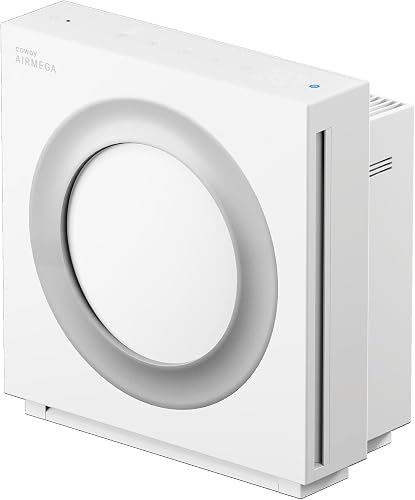
- Numerical particle display
- PM1, PM2.5 and PM10 sensor
- Smart, Eco and Sleep modes
- Filter-life percentage display
A numerical particle display and separate filter-life indicators suit buyers who prefer checking the purifier itself. The slide-out pre-filter makes routine access simple.
Pros
- Numerical air quality readings
- Pre-filter slides out without removing front cover
- Coway provides a 3-year limited warranty
Cons
- Max2 filter requires replacement
- Particle readings do not measure every pollutant
The Coway Mighty2 suits buyers who want numerical particle readings on the unit. Its MegaScan laser sensor detects PM1, PM2.5 and PM10, with a color indicator alongside the number.
That display helps you follow changes in room conditions, but a particle reading does not measure every gas or odor. Use it as feedback about particles near the sensor, rather than proof that every part of the room is clean.
Coway gives CADR figures of 242 for dust, 240 for smoke and 249 for pollen. Smart Mode adjusts airflow, Eco-Mode responds to clean air, and a light sensor triggers Sleep Mode in darkness.
Maintenance access is a strong reason to choose it. The washable pre-filter slides out without removing the front cover, and the display tracks remaining life for both the pre-filter and combined HEPA/carbon Max2 filter.
Coway backs the Mighty2 with a 3-year limited warranty. Choose it if clear local feedback and convenient filter access matter more than remote operation.
Skip it if your main need is greater airflow for a very broad room. Its detailed display does not replace adequate capacity.
Blueair Blue 311i Max: Best for living room offices

- 439 sq ft in 12.5 minutes
- HEPASilent dual filtration
- App scheduling and filter tracking
- QuietMark certified
App scheduling and a published sound range suit a shared living and working space. Its shorter-interval coverage is a better sizing guide than its maximum area.
Pros
- App schedules operation
- Automatic fan adjustment
- 360-degree air intake
Cons
- Less shorter-interval coverage than the 211i Max
- Needs open space around its intake
The Blueair Blue 311i Max suits a living room that doubles as a work area. App scheduling, automatic fan adjustment and filter-life tracking help you set a routine around the hours you spend there.
Blueair states 439 sq ft in 12.5 minutes, and its CADR is 250 for smoke, dust and pollen. That makes it a more natural choice for a defined room than for a sprawling connected floor.
Its HEPASilent system combines mechanical and electrostatic filtration. Blueair says it captures 99.97% of airborne particles down to 0.1 microns, including dust, pollen, pet dander and smoke.
Blueair gives a sound range of 23–50 dB and QuietMark certification. Plan around the sound at the speed your room needs, since the quietest setting is not the maximum-airflow setting.
Choose it if your room fits its shorter-interval coverage and you value scheduled operation. Its 360-degree intake needs clear space around the body.
Skip it for a much larger open area where the 211i Max is a better capacity match. For sleep-focused choices, see our best air purifiers for bedrooms.
Levoit Core 600S-P: Best for open family rooms

- CADR 391 CFM
- 606 sq ft every 12.5 minutes
- Three-stage filtration
- Automatic fan adjustment
Higher airflow makes this the Levoit to consider when a broad, connected room needs more capacity. Choose it over the Vital when room volume drives the decision.
Pros
- Higher CADR than the Vital 200S-P
- Auto Mode adjusts fan speed
- Replacement filter choices for different needs
Cons
- Taller than the Vital 200S-P
- Maximum coverage means only one air change per hour
The Levoit Core 600S-P is the Levoit to choose when room volume matters more than pet-focused inlet design. Its 391 CFM CADR provides more airflow than the Vital 200S-P.
Levoit states that it refreshes 606 sq ft every 12.5 minutes or 2,933 sq ft once per hour. Use the shorter interval when judging a frequently occupied family room, rather than treating the maximum area as a frequent-cleaning recommendation.
The purifier uses 3-stage filtration and Auto Mode to adjust fan speed. Levoit offers replacement filter options aimed at pet-related particles and odors, smoke, or gases.
Levoit's HEPA-grade description applies to Sleep Mode with its Original Filter. Choose a replacement filter for your actual needs and follow the operating guidance for that filter.
This model suits an open family room where a smaller unit would need to work near its limit. Its taller body also needs a spot that leaves the outlet clear.
Skip it if your room fits a smaller purifier and the extra capacity would force awkward placement. It also cannot distribute clean air evenly through a home divided by closed doors.
Blueair Blue 211i Max: Best for expansive shared spaces

- 674 sq ft in 12.5 minutes
- HEPASilent filtration
- App scheduling and filter tracking
- Washable fabric pre-filter
The largest shorter-interval coverage figure here makes this a candidate for broad shared rooms. App controls and a washable fabric pre-filter support regular household use.
Pros
- Largest stated shorter-interval area in this group
- App control and automatic fan changes
- 360-degree air intake
Cons
- Wider footprint than the other picks
- Maximum coverage is a one-hour figure
The Blueair Blue 211i Max suits a broad shared room where the smaller Blueair would be undersized. Its 674 sq ft in 12.5 minutes is the largest shorter-interval area stated among these picks.
Blueair also gives maximum coverage of 3,235 sq ft in an hour. That figure describes a slower refresh rate, so do not use it as the target room size for frequent particle removal.
HEPASilent filtration combines mechanical and electrostatic methods to capture airborne particles. Built-in sensors adjust the fan, and the app supports monitoring, settings, schedules and filter-life tracking.
Choose it if the larger shorter-interval area matches your floor plan and remote controls will help your household use it consistently. The washable fabric pre-filter gives you a reusable layer for larger particles.
Its 14.4 x 14.4-inch footprint needs deliberate planning. Keep the 360-degree intake open instead of pushing the unit between a sofa and a wall.
Skip it if you cannot give it that space or need separate closed rooms covered at once. For smoke concerns, our guide to air purifiers for smoke explains the limits of particle filtration.
How should you size a purifier for your large room?
Size the purifier for room volume and frequent air changes, then check that you can tolerate the required fan speed. Floor area alone misses high ceilings and the effect of connected spaces.
Measure length times width for each open section, then add those areas together. Include an open dining area connected to your living room, but treat a bedroom behind a closed door separately.
Choosing the best air purifier for large rooms by CADR
Use CADR to estimate how quickly a purifier can supply filtered air to your room. When CADR is in CFM, multiply it by 60 and divide by room volume in cubic feet to estimate equivalent air changes per hour.
For example, a 20 x 20-foot room with an 8-foot ceiling contains 3,200 cubic feet. A 250 CFM purifier supplies 15,000 cubic feet per hour, which works out to about 4.7 equivalent air changes.
Raise that ceiling to 12 feet and the same airflow gives about 3.1 equivalent air changes. This is why a tall room needs more capacity even when its floor area stays the same.
Several air changes per hour provide more frequent particle removal than one. The right pace depends on the source of particles, room use and how much outside or adjoining air enters.
When should you choose two purifiers?
Choose two units when separate occupied areas have poor airflow between them. A hallway, partial wall or closed door can prevent one central purifier from serving both spaces well.
For a single broad room, compare one larger unit with two smaller units placed near different occupied zones. Include replacement filters, usable outlets and floor space in that decision.
Which features matter for your household?
Choose filtration for the pollutant and controls for your routine. A feature matters when it helps the purifier address your main concern or keeps it running regularly.
For pet hair and dust, accessible pre-filters make upkeep easier. Much of the visible debris still settles on surfaces, so pair filtration with vacuuming and damp dusting.
For pollen and dander, give adequate particle-cleaning airflow priority over app features. A convenient app cannot make up for a purifier that is too small for the room.
For odors, look for carbon filtration and remove the source whenever possible. The carbon amount and contact time affect gas removal, so a carbon feature alone does not establish how long odor control will last.
Automatic modes are useful for responding to changing particle levels. Their sensors describe conditions near the purifier, so they may miss a source on the far side of an open room.
Noise also changes the buying decision. If you will turn a purifier down during calls or television time, leave some capacity margin rather than sizing around its maximum setting alone.
Where should you put a large-room air purifier?
Place it inside the room you want to clean, with clear intake and outlet paths. Follow the manual's clearance guidance rather than choosing a hidden spot that blocks circulation.
Keep curtains, sofa sides and storage baskets away from air openings. Avoid positions where the outlet blows straight into a nearby shelf or the intake pulls from a narrow furniture gap.
For a combined living and dining room, start near the area where people spend the most time. Adjust the position if a wall or large piece of furniture separates the occupied zones.
Use a stable, dry location with a safe cord route. Our air purifier placement guide explains how to plan around walls, furniture and everyday activity.
Before the first start, remove filter packaging as directed and seat each filter correctly. Confirm which side faces outward, then check the fan and mode settings before leaving it to run.
How do you keep airflow strong over time?
Keep the pre-filter clear and replace disposable filters as directed. Large rooms can expose a purifier to plenty of dust and hair, especially when pets spend the day nearby.
Check the pre-filter regularly at first so you learn how quickly debris builds up in your home. Follow the manual's cleaning method, and let washable parts dry fully before putting them back.
Do not assume that a washable pre-filter makes the HEPA or carbon stage washable. Water can damage filters that are designed for replacement.
Treat filter-life indicators as maintenance prompts and also inspect for blocked airflow. Our guide to how often to change an air purifier filter explains why household conditions affect the schedule.
Keep a simple note of cleaning and replacement dates. Check the exact model compatibility before ordering replacements, especially when a brand sells several similar-looking filters.
Which mistakes should large-room buyers avoid?
Avoid sizing by maximum coverage, blocking airflow and running only in short bursts. These habits can leave a capable purifier doing less useful work than expected.
Do not assume a high filter capture percentage means fast room cleaning. Air has to reach the filter, so compare airflow as well as filtration.
Do not count quiet-mode coverage as equal to maximum-speed coverage. Check the mode after the room darkens, especially on models that switch automatically to Sleep Mode.
Run the purifier consistently while the room is occupied instead of expecting a short session to handle an ongoing source. Close exterior openings when trying to limit outdoor particles, while managing indoor sources with suitable ventilation.
Keep cooking emissions, smoke and dampness in perspective. Use a kitchen exhaust system for cooking, remove smoke sources, and address leaks or moisture rather than expecting a purifier to solve the cause.
Which is the best air purifier for your large room?
The best air purifier for large rooms is the one that fits your measured space at a speed you'll keep using. Make capacity the first decision, then choose the controls and maintenance features that suit your household.
Pick the Vital 200S-P for a pet-filled living room within its airflow capacity. Choose the Winix 5510 for remote control, or the 5520 when its smaller body makes placement easier.
Choose the Coway Mighty2 for numerical readings and easy pre-filter access. The Blueair 311i Max fits a defined living or working room, while the Core 600S-P and Blueair 211i Max deserve priority for larger open areas.
Before ordering, use our air purifier size and CADR guide to check your room volume and cleaning pace. Then mark out the purifier's footprint and confirm that the intake, outlet and filter access will stay clear.
Our top 3 picks at a glance
-
1
-
2
-
3
Frequently asked questions
How do I choose an air purifier for a large room?
Choose by CADR, room volume and the fan speed you can keep running. Measure connected open areas together, then compare coverage at the same cleaning interval.
Our room size guide explains the measurements, including why high ceilings call for more airflow than floor area alone suggests.
What does CADR mean on an air purifier?
CADR means Clean Air Delivery Rate, the volume of filtered air a purifier supplies each minute for a given particle type. Higher CADR supports faster particle removal in the same room.
Our air purifier size and CADR guide explains how airflow, room volume and air changes fit together.
Can one air purifier clean an open floor plan?
One suitably sized purifier can serve a connected open area, but walls, corners and closed doors limit air movement. Treat separate bedrooms as separate spaces rather than adding them to a whole-home claim.
Our air purifier placement guide helps you find a clear location within the area you use.
Are the largest coverage numbers comparable?
Compare maximum coverage figures only when the cleaning interval and room assumptions match. An area quoted for one hour is not equivalent to the same area refreshed several times an hour.
Use shorter-interval coverage or CADR to judge whether a model can maintain the cleaning pace you want.