Levoit vs Coway Air Purifiers: Which Is Better? (October 2026)
Choose the Levoit Vital 200S-P for pet households and stronger airflow than the Core 300-P in this Levoit vs Coway comparison. Pick the Core for a smaller bedroom or the Coway AP-1512HH for automatic fan adjustment and a washable pre-filter.
On this page (13 sections)
- Levoit vs Coway: which model fits your home?
- How should you compare airflow and room coverage?
- Who should buy the Vital 200S-P, and who should skip it?
- Who should buy the Core 300-P, and who should skip it?
- Who should buy the Coway AP-1512HH, and who should skip it?
- Which is better for airborne dust and allergies?
- Which model makes sense for pets and odors?
- What should you expect from the everyday controls?
- How should you set up either brand?
- How much space do these models need?
- What filter care should you plan for?
- Side-by-side Levoit and Coway specifications
- The Levoit vs Coway decision
Choose the Levoit Vital 200S-P for pet households and stronger airflow than the Core 300-P in this Levoit vs Coway comparison. Pick the Core for a smaller bedroom or the Coway AP-1512HH for automatic fan adjustment and a washable pre-filter.
The right choice starts with the room you want to clean, then the fan settings and upkeep you'll use. A compact purifier that runs consistently can serve a small bedroom well, while a busy living area needs more airflow.
These recommendations apply to these 3 models. They do not make every Levoit a better choice than every Coway, or the reverse.


Levoit vs Coway: which model fits your home?
The Vital suits pet-heavy living spaces, the Core suits smaller bedrooms, and Coway suits buyers who want automatic control. Start with that split, then check room size before choosing.
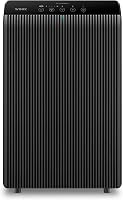
The Vital's appeal is its airflow advantage over the smaller Core and an inlet design aimed at airborne pet hair. It makes sense for a shared room where people and pets spend much of the day.
The Core is easier to fit into a small room, but it needs you to select the fan speed. Choose it when simple controls and a compact body matter more than automatic adjustment.
Coway offers a different daily routine: its sensor changes fan speed as detected air quality changes. Its washable pre-filter also suits buyers willing to clean a reusable first stage.
If you're still deciding what kind of unit you need, our air purifier size-and-need guide puts these choices in a wider context.
How should you compare airflow and room coverage?
Compare CADR at a useful cleaning rate, rather than choosing the largest square-foot figure on the box. CADR measures clean air delivery, while coverage also depends on how often that air moves through the purifier.
The Vital has smoke, dust and pollen CADR figures of 250, 254 and 289 CFM. The Core's corresponding figures are 143, 153 and 167 CFM, so the Vital has a clear airflow advantage between these 2 models.
Both Levoit models carry AHAM Verifide certification. The Association of Home Appliance Manufacturers explains its air cleaner verification program.
Coway describes coverage of up to 1,748 sq ft in 60 minutes. Without a corresponding Coway CADR figure here, we would not rank its airflow against the Vital from maximum coverage alone.
Levoit vs Coway coverage claims need the same yardstick
Air changes per hour make coverage figures meaningful because they show how often an equivalent room volume passes through the purifier. A once-per-hour claim describes a different cleaning pace from several changes per hour.
The Core illustrates this clearly: Levoit gives it coverage of 222 sq ft at 4.8 air changes per hour, or 1,073 sq ft at once per hour. For frequent cleaning in an occupied bedroom, use the smaller figure as your starting point.
The Vital's maximum claim is 1,875 sq ft without a stated air-change rate at that area. Don't read that as a promise of frequent cleaning across an entire open-plan home.
Measure room length and width, and account for unusually high ceilings or connected spaces. Our guide to CADR and room sizing explains how to turn those measurements into a more useful comparison.
Who should buy the Vital 200S-P, and who should skip it?
Buy the Vital for a pet household or when the Core's airflow is too limited for your room. Its extra capacity is the main reason it leads our picks.
Levoit combines a traditional inlet with an additional U-shaped inlet intended to draw in airborne pet hair without clogging. That design is relevant around shedding pets, though you still need to remove collected hair during regular care.
Its size also makes more sense in a shared living area than in a cramped corner beside a bed. Plan its position before ordering so furniture won't crowd either inlet.
Skip the Vital if your only task is cleaning a modest bedroom and you value the smallest possible body. The Core is easier to accommodate for that use.
Also pause if a particular smart feature is essential to your routine. The Vital is a smart purifier, but confirm the exact function you need rather than assuming that label covers every control.
Who should buy the Core 300-P, and who should skip it?
Buy the Core for a smaller bedroom or office where you'll choose the speed yourself. Its compact design is useful when floor space is tight.
Levoit gives its Sleep Mode a noise figure of 24 dB, and the display lights can be switched off. That combination suits people who want a dark room and a quieter overnight setting.
The quiet figure applies to Sleep Mode, not every fan speed. If you need stronger airflow throughout the night, consider the sound at the speed you expect to use.
Skip the Core if you want sensor-based fan adjustment. This is the Core 300-P, not the Core 300S-P, and it requires manual control.
Also skip it for a large connected living space where its small size is the main attraction. Our quiet air purifier guide can help you balance sound, room fit and nighttime use.
Who should buy the Coway AP-1512HH, and who should skip it?
Buy Coway if automatic fan adjustment fits your routine better than manual speed changes. Its air quality sensor, Auto Mode and care alerts make it practical for an occupied room.
The sensor feeds an air quality indicator and adjusts fan speed in Auto Mode. You can turn off the indicator light for sleep, though automatic speed changes may still be noticeable.
Coway also includes Eco Mode. Choose it for the control options you want, rather than assuming a particular energy saving without matching usage information.
Its filtration system combines a washable pre-filter, deodorization filter, HEPA filter and Bipolar Device. Buyers who specifically want filtration alone should consider that last component before choosing this model.
Skip Coway if you need the smallest footprint or dislike fan speeds changing on their own. It is also a poor fit if you expect the washable pre-filter to remove the need for replacement filters.
Which is better for airborne dust and allergies?
The Vital is our first choice over the Core for airborne dust and pollen, thanks to its higher delivery rates for those particles. That recommendation concerns air cleaning, not a promise of symptom relief.
A filter's particle capture percentage and a purifier's CADR answer different questions. Capture efficiency describes filtration, while CADR helps show how quickly filtered air is delivered.
Levoit reports 99.97% filtration efficiency for particles from 0.1 to 0.3 microns for the Core. Coway reports 99.97% reduction of 0.3 micron particles, but those percentages alone do not establish which unit will clean your room faster.
Use a purifier alongside regular vacuuming, damp dusting and bedding care. Dust sitting on a shelf or allergens caught in fabric must become airborne before an air purifier can collect them.
For a bedroom, keep the unit running during the hours you use the space instead of switching it on only after discomfort starts. Our guide to how air purifiers help with allergies explains their role and limits.
Which model makes sense for pets and odors?
Choose the Vital for airborne pet hair, with Coway as an alternative for buyers who prefer a washable first stage. Treat odor control as one part of pet care.
Levoit offers a Pet Allergy replacement filter for the Vital, intended to capture fur and absorb unpleasant odors. Its other options include Smoke Remover and Toxin Absorber filters aimed at different needs.
Choose a replacement for your main concern rather than assuming every version performs identically. A filter change can alter the balance of particle capture, odor control and airflow.
Coway's deodorization stage is intended to reduce odors and volatile organic compounds. Neither odor reduction nor a fresher-smelling room establishes that all indoor pollutants have been removed.
Place the purifier where it can circulate room air, while keeping cords away from chewing pets. Continue cleaning litter areas and washing pet bedding; our pet odor guide explains why source cleaning matters.
What should you expect from the everyday controls?
Coway reduces routine fan adjustments, while the Core gives you direct manual control. Pick the approach you'll use consistently.
The Core has touch controls, a check-filter indicator and a timer with 2, 4, 6 or 8-hour options. The timer helps with a planned session, but it can also leave the room without filtration if you forget it is set.
For ongoing dust or pet concerns, choose a sustainable running schedule instead of relying on short bursts. Use a higher speed when you need more cleaning and a lower speed when sound would otherwise make you switch the unit off.
Coway's sensor is a useful control aid, not a complete assessment of everything in the room. Don't use a favorable indicator color as a reason to ignore a known source of smoke or odor.
How should you set up either brand?
Unpack the filter, keep airflow clear and start in the room you use most. A good position matters more than hiding the purifier neatly behind furniture.
Before plugging in, follow the manual to open the filter compartment and remove any protective packaging. Check that the filter is seated correctly and the cover is secured.
Keep the intake and outlet away from curtains, bedding and furniture, using the manufacturer's clearance instructions. Avoid a tight alcove that lets cleaned air loop straight back into the intake.
For a bedroom, choose a stable location where the unit won't become a trip hazard. Keep the cord clear of walkways and pet access.
The Core requires 120V power and is intended only for use in the United States. Check electrical requirements before choosing it for use elsewhere.
For more help with doors, room layout and blocked airflow, follow our air purifier placement guide.
How much space do these models need?
The Core is easiest to fit, while Coway needs the widest clear space. Measure the usable location with airflow clearance included.
The Core measures 8.7 by 8.7 by 14.2 inches and weighs 7.9 lb. It is the smallest and lightest of these models.
The Vital measures 14.96 by 8.66 by 19.69 inches and weighs 13.2 lb. Coway measures 9.6 by 16.8 by 18.3 inches and weighs 12.5 lb.
Don't plan to move a single unit between several rooms and expect continuous cleaning in all of them. Put it where the need is greatest, then assess other rooms separately.
What filter care should you plan for?
Plan for both cleaning and replacement, even if you choose Coway's washable pre-filter. A reusable first stage does not make the entire filter system washable.
Unplug the purifier before opening it for care. Clean only the parts and surfaces that the manual permits, and let washed components dry fully before reinstalling them.
Coway's alerts signal pre-filter cleaning and filter replacement based on processed airflow. Use those reminders alongside checks for visible buildup.
Levoit recommends changing the Core's filter every 6 to 8 months and using official replacements. Its published CADR and coverage figures apply to the Original Filter, so don't assume another filter preserves those figures.
Before buying, check that the correct replacement is easy for you to obtain. Our filter replacement guide explains how room conditions affect care needs.
For Levoit upkeep, use our cleaning guide alongside your model's manual. Never rinse a filter just because it looks similar to a washable one.
Side-by-side Levoit and Coway specifications
Use the table to check physical fit after deciding on airflow and controls. A model that suits your habits still needs a suitable place to run.
| Product | Best for | Room claim | Size | Weight | Our score |
|---|---|---|---|---|---|
| Levoit Vital 200S-P | busy pet households | Up to 1,875 sq ft | 14.96 x 8.66 x 19.69 in | 13.2 lb | 9.2 |
| Levoit Core 300-P | smaller bedrooms | 222 sq ft at 4.8 air changes per hour | 8.7 x 8.7 x 14.2 in | 7.9 lb | 8.8 |
| Coway AP-1512HH | automatic fan control | Up to 1,748 sq ft in 60 minutes | 9.6 x 16.8 x 18.3 in | 12.5 lb | 8.7 |
Before ordering, confirm 3 things: the room's cleaning needs, the space around the purifier and the correct replacement filter. Those checks prevent more buying mistakes than choosing by a brand name or maximum coverage number.
The Levoit vs Coway decision
Choose the Vital 200S-P when pet hair or the need for more airflow than the Core drives your decision. Skip the larger body if a small bedroom is your only target.
Choose the Core 300-P when compact size, manual controls and a dark display fit your nightly routine. Choose Coway AP-1512HH when you prefer automatic fan adjustment and will keep up with its washable pre-filter.
Settle your Levoit vs Coway choice around the room where the purifier will actually run. If Levoit fits your needs but you want more model options, use our best Levoit air purifier guide as the next step.
Frequently asked questions
Is Levoit or Coway better?
Choose the Levoit Vital 200S-P for pet households or stronger airflow than the Core 300-P; choose Coway AP-1512HH for sensor-based fan adjustment and a washable pre-filter. The Core suits smaller bedrooms with manual controls, so the right choice depends on your room and daily routine rather than the brand alone.
Which is better for a bedroom, Levoit or Coway?
The Levoit Core 300-P suits smaller bedrooms because of its compact body, display-off control and Sleep Mode; its quietest setting moves less air than higher fan speeds, so size it for the room first. Coway is a better fit if automatic fan adjustment matters more than a small footprint.
Which Levoit or Coway air purifier is best for pets?
The Levoit Vital 200S-P is our pet-focused choice because its extra U-shaped inlet is designed for airborne hair; Levoit also offers a Pet Allergy replacement filter for fur and odors. Keep vacuuming floors and washing pet bedding, since an air purifier cannot collect hair that stays on surfaces.
Does the Coway AP-1512HH have an automatic mode?
Yes, the Coway AP-1512HH uses an air quality sensor to adjust fan speed in Auto Mode; it also includes Eco Mode, an air quality light and filter alerts. The Core 300-P requires manual fan selection, so choose Coway if you want fewer routine speed adjustments during the day.
How should I compare air purifier room coverage?
Compare CADR and air changes per hour before comparing maximum floor area; a purifier that cleans a large space once an hour provides less frequent cleaning than one sized for several air changes. Measure your room, account for ceiling height and avoid treating different brands' largest coverage claims as equivalent.